

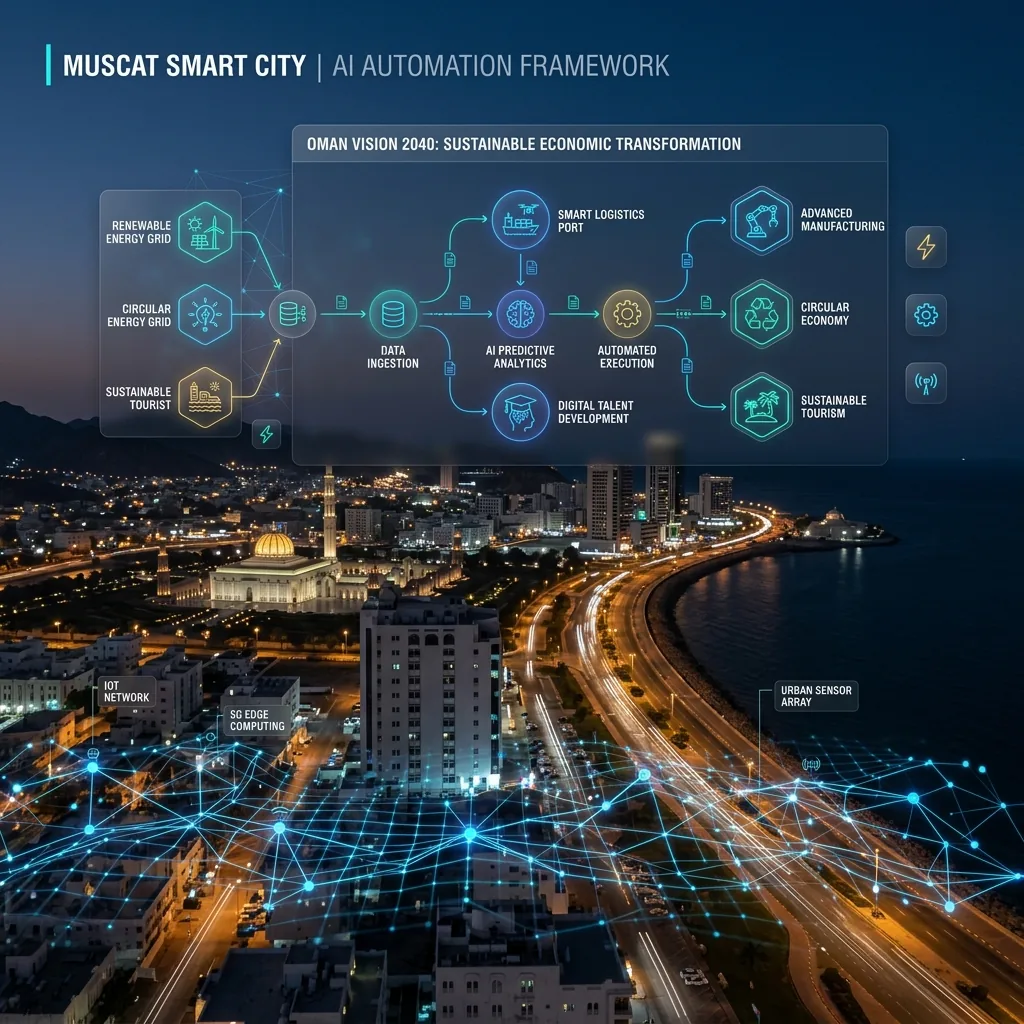
Navigating economic transformation in the Sultanate of Oman requires business leadership to maintain a sharp focus on national priorities while simultaneously scaling profitability. As corporate boards in Muscat work toward operational excellence, the imperative to align private sector initiatives with the national economic mandate of Oman Vision 2040 has never been more urgent.
Artificial intelligence and automated workflow systems serve as the core catalyst driving this national transition. By converting manual administrative overhead into high-throughput digital pipelines, forward-thinking business leaders in Muscat, Sohar, and Salalah are unlocking unprecedented capacity while directly contributing to Oman's target of building a competitive, knowledge-based economy.
How does AI automation drive national economic diversification?
AI automation accelerates economic diversification by scaling non-oil industry productivity while decreasing core operational expenses across logistics, tourism, and financial services.
Oman Vision 2040 establishes a clear trajectory away from hydrocarbon dependency, aiming to increase the non-oil sector share of national GDP significantly. Enterprise automation serves as the primary engine for this diversification. When Omani commercial institutions automate legacy document verification, inventory auditing, and client onboarding, operational processing times shrink from days to minutes. For instance, mid-sized enterprises adopting automated intelligence report a direct 35% reduction in recurring administrative expenses alongside a 40% jump in task execution speed.
In logistics centers operating across Port of Salalah and Sohar Freezone, intelligent analytics platforms now optimize cross-border customs documentation automatically. This eliminates costly freight bottlenecks and integrates regional GCC supply networks into a unified, agile trade ecosystem.
How can Omani enterprises maximize Omanization through AI deployment?
AI deployment elevates Omanization by automating repetitive manual labor and empowering Omani professionals to execute high-value strategic decision-making.
A common misconception among organizational leaders is that automation conflicts with national workforce development goals. On the contrary, automated workflow integration directly reinforces Omanization initiatives by redirecting human talent toward complex, creative, and customer-centric responsibilities.
Rather than spending 25 hours per week manually compiling cross-departmental spreadsheets or processing basic inquiry tickets, Omani employees leverage centralized AI management dashboards. The quantitative impact on corporate talent retention and productivity is significant:
- Reduction in manual processing errors: Down by 92% across customer service and data entry pipelines.
- Workforce capacity expansion: Up to 15 hours saved per employee every week, reallocated directly into executive strategic execution.
- Skills elevation: Upskilling local talent into AI workflow managers, data auditors, and automated systems supervisors.
What are the regulatory requirements for AI data privacy under Omani law?
Enterprise AI deployments must comply strictly with Royal Decree 6/2022 regarding Personal Data Protection Law (PDPL) by maintaining localized data governance.
When executing enterprise digital transformation across the Sultanate, corporate governance teams must ensure that AI architectures strictly uphold Omani Personal Data Protection Law (PDPL). Unauthorized cross-border transfer of sensitive customer credentials or proprietary financial metrics presents critical legal risks.
"Building a resilient digital economy in Oman hinges upon absolute data sovereignty, robust regulatory compliance, and responsible AI implementation."
To navigate these regulatory standards seamlessly, Omani firms are increasingly adopting localized hybrid cloud deployments or secure enterprise environments. Partnering with localized technology advisors like AI Profit Lab ensures that retrieval-augmented generation (RAG) models and automated agents process enterprise metrics within sovereign data boundaries while complying with all guidelines set by the Ministry of Transport, Communications and Information Technology (MTCIT).
What is the step-by-step roadmap for Vision 2040 AI alignment?
Aligning corporate operations with Vision 2040 requires a four-phase strategy: workflow auditing, sovereign architecture design, pilot deployment, and local team upskilling.
- Identify Repetitive Friction Points: Audit existing internal workflows to spot high-volume, rules-based tasks such as invoice processing, compliance checks, or bilingual client inquiries.
- Design Sovereign Infrastructure: Establish encrypted, PDPL-compliant data pipelines that connect existing ERP systems (such as SAP or Oracle) with modern AI agent capabilities.
- Launch a 30-Day High-Impact Pilot: Focus initial implementation on a single operational department—such as customer support or procurement—to measure empirical ROI (targeting 30%+ cost savings).
- Empower Local Teams: Train Omani staff to supervise, query, and refine automated systems, cementing sustainable technological self-reliance.