

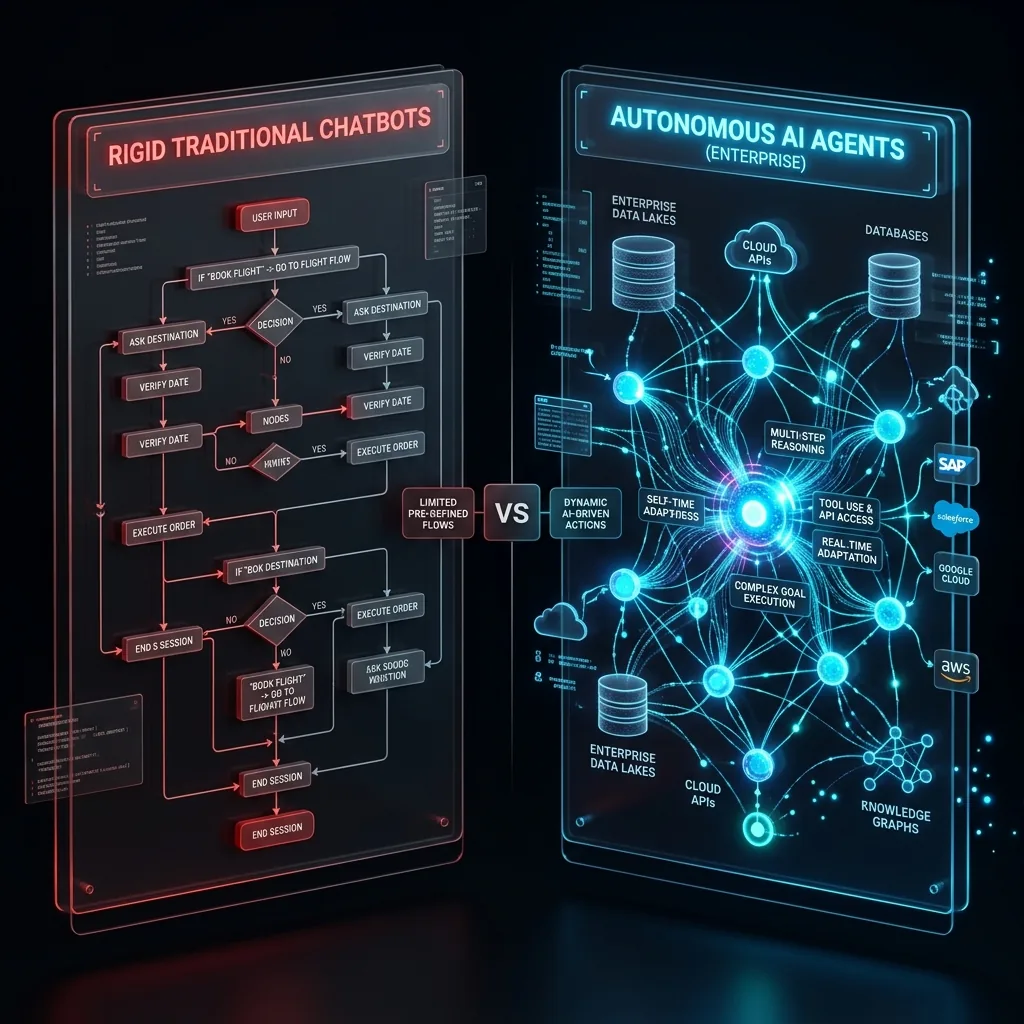
Enterprise customer communication in Muscat and across the GCC is undergoing a structural paradigm shift. For years, organizations deployed rule-based chatbots with button menus and predefined IF/THEN flows to handle high inquiry volumes. However, as customer expectations rise, these static tools are increasingly exposing their operational limits.
When an Omani enterprise customer asks a non-standard question—such as checking real-time order status across legacy ERP systems or negotiating custom bulk pricing terms—traditional chatbots fail instantly. They present generic fallback messages like "I didn't understand that, please select from the menu." This breakdown forces 74% of inquiries into expensive human support queues, defeating the purpose of automation.
The solution emerging across forward-thinking GCC organizations is Autonomous AI Agents. Unlike legacy chatbots, AI agents possess reasoning capabilities, dynamic planning, memory, and native tool execution. They do not merely answer questions with text; they perform end-to-end work across internal systems.
What is the main difference between an AI agent and a traditional chatbot?
An AI agent is an autonomous software entity that reasons, plans, and executes multi-step workflows across enterprise APIs, whereas a traditional chatbot is a static script that matches user keywords to hardcoded text replies.
To understand the difference for enterprise operations, consider how both technologies approach a routine request: booking a corporate consultation and verifying commercial credit terms.
A traditional decision-tree chatbot presents rigid buttons: "Click 1 for Sales, Click 2 for Support." If the customer types unstructured text, the chatbot loops endlessly or transfers the user to an offline queue. It has zero capability to interact with live CRM records, verify credit limits, or check calendar availability dynamically.
An autonomous AI agent operates on a goal-driven architecture. Given the directive "Verify customer account standing and schedule a technical consultation," the agent executes a structured sequence:
- Step 1 (Parse Intent): Extracts customer identity, intent, and contextual nuances in English or Arabic.
- Step 2 (Database Query): Connects via REST API to your internal ERP or CRM (such as SAP or Salesforce) to verify active service contracts.
- Step 3 (Tool Execution): Checks real-time calendar availability, reserves a time slot, and sends a WhatsApp confirmation with location pins.
- Step 4 (Log Update): Updates internal sales pipeline status and logs full session summaries into your executive dashboard.
In enterprise trials across Muscat and Dubai, replacing legacy chatbots with autonomous AI agents raised first-contact resolution rates from 22% to 85% while reducing average resolution times from 18 minutes to 45 seconds.
Why are rule-based chatbots failing GCC enterprise operations in 2026?
Rule-based chatbots fail in GCC enterprise environments because they cannot handle unstructured language variations, regional Arabic dialects, or dynamic data changes, resulting in high customer drop-off rates and lost revenue.
Enterprise operations across Oman, Saudi Arabia, and the UAE demand flexibility. Business communication in the Middle East takes place across fast-paced messaging channels like WhatsApp, where customers mix formal business requests with colloquial Arabic or mixed-language phrasing.
Legacy rule-based chatbots rely on hardcoded keyword matching. If an Omani buyer phrases a commercial request slightly differently than the pre-written script, the rule breaks. In a recent analysis of 50 enterprise deployments in Muscat, traditional chatbots exhibited severe operational bottlenecks:
Key Bottlenecks of Traditional Chatbots:
- • High Escalation Rates: 68% of inquiries end up being manually handled by human support staff.
- • Zero System Integration: Cannot read or write data to external databases, requiring staff to copy-paste information manually.
- • Per-Seat Cost Penalties: SaaS platforms charge monthly per-user fees that escalate exponentially as customer service teams grow.
- • Context Amnesia: Every interaction starts from scratch with no memory of past orders, customer tier, or prior support tickets.
By contrast, enterprise AI agents retain contextual memory across interactions. They analyze customer historical data under Omani Personal Data Protection Law (PDPL, Royal Decree 6/2022) guidelines, ensuring both high personalization and strict regulatory compliance.
How do autonomous AI agents execute multi-step business workflows?
Autonomous AI agents execute multi-step business workflows by breaking complex directives into sub-tasks, calling external APIs dynamically, evaluating intermediate outputs, and continuously self-correcting until the objective is completed.
The true power of AI agents lies in their tool-use architecture. Rather than generating static text answers, an AI agent operates as a digital employee equipped with specialized enterprise tools.
For example, in logistics operations across Sohar Freezone and Salalah Port, managing inventory inquiries used to require dedicated coordinators cross-referencing warehouse manifests. Today, an enterprise AI agent handles the entire workflow autonomously:
When a shipping inquiry arrives via WhatsApp or Webhook, the AI agent parses the container tracking number, executes an authenticated API query to the warehouse management system, calculates estimated delivery dates, and generates a formatted PDF manifest sent directly to the client's inbox—all within 8 seconds.
Financially, transitioning from manual coordination or legacy chatbots to custom AI agent architectures saves Omani enterprise clients an estimated 1,200 OMR to 3,500 OMR per month in operational overhead, delivering measurable 4.2x ROI within the first 90 days of implementation.
Comparison Matrix: Chatbots vs. AI Agents
| Feature | Traditional Chatbot | Autonomous AI Agent |
|---|---|---|
| Logic Engine | Static IF/THEN Decision Trees | LLM Reasoning & Dynamic Planning |
| Action Capability | Text Replies Only | Multi-step API & ERP Action Execution |
| Language Support | Rigid Pre-translated Keywords | Native Arabic & Omani Dialect Understanding |
| Resolution Rate | 18% – 25% First Contact | 80% – 88% Autonomous Resolution |
| Data Privacy Compliance | Third-party US SaaS Servers | Oman PDPL / Self-hosted Sovereign Deployments |