

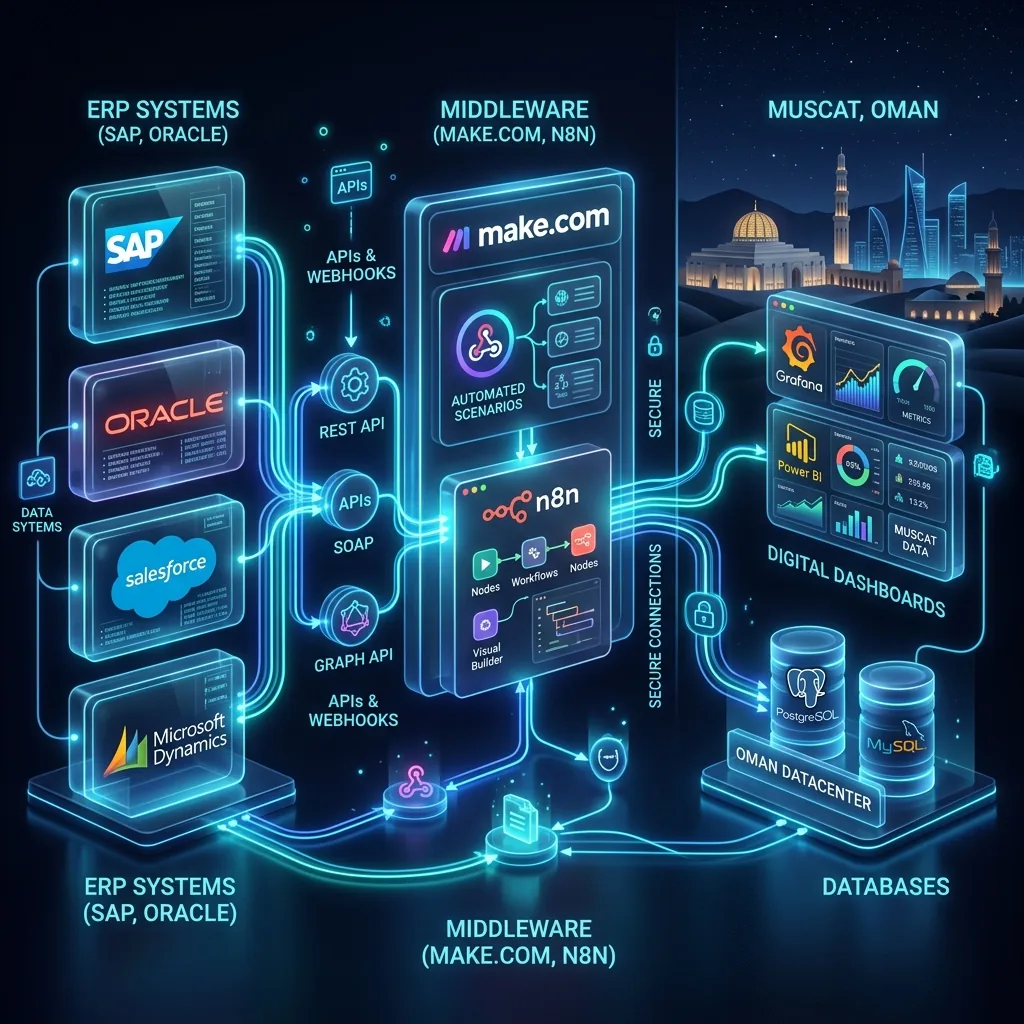
Modern enterprises operating in Muscat, Sohar, and Salalah rely on Enterprise Resource Planning (ERP) systems such as SAP S/4HANA, Oracle Fusion, and Microsoft Dynamics 365 to run core logistics, finance, and supply chain operations. However, legacy batch processing and rigid custom ABAP or PL/SQL scripts often lock critical business data in data silos. When sales teams in Muscat need instant updates on incoming shipment containers or finance teams require real-time invoice matching, traditional polling methods waste immense server bandwidth and create costly operational delays.
Connecting event-driven Webhooks with modern middleware platforms like Make.com and n8n bridges the gap between massive ERP legacy databases and modern business applications. By routing real-time HTTP payloads through visual workflow orchestrators, enterprise IT directors across Oman can automate multi-step business logic in seconds rather than months. In this technical blueprint, we detail exact architectural patterns, payload structures, security protocols, and Omani Personal Data Protection Law (PDPL) compliance frameworks required to connect webhooks to enterprise ERPs effectively.
How do webhooks enable real-time ERP data streaming in Omani enterprises?
To enable real-time ERP data streaming in Omani enterprises, webhooks act as event-driven HTTP callbacks that push JSON payloads instantly when a database mutation occurs, eliminating wasteful API polling cycles.
Traditional ERP integrations rely on scheduled cron jobs that poll REST or SOAP endpoints every 15 to 30 minutes. For an industrial distributor in Sohar handling 5,000 inventory items daily, polling drains system resources and causes latency. Webhooks invert this architecture: whenever a warehouse worker updates a stock level in SAP, the ERP immediately pushes a lightweight HTTP POST request to an external listening endpoint hosted on Make.com or n8n.
Below is a typical JSON payload emitted by an enterprise ERP webhook when a purchase order is updated in Muscat:
{
  "event": "purchase_order.updated",
  "timestamp": "2026-08-04T10:15:30Z",
  "organization_id": "OM-MUSCAT-8840",
  "data": {
    "po_number": "PO-994021",
    "vendor": "Al-Hassan Logistics LLC",
    "total_value_omr": 42500.500,
    "status": "APPROVED",
    "line_items": 14
  },
  "signature": "sha256=d3b07384d113edec49eaa6238ad5ff00"
}
Because webhooks only fire when actual work happens, compute consumption drops by up to 85% compared to constant polling cycles. This enables real-time synchronization between core financial databases and operational dashboards across GCC branch offices. For mission-critical mobile agents and customer bots requiring sub-second response times, learn how to optimize webhook latency for real-time AI responses on mobile connections.
Make.com vs. n8n: Which integration platform fits your Omani ERP architecture?
To choose between Make.com and n8n for your Omani ERP architecture, evaluate data residency constraints under the Omani PDPL, workflow complexity, and your internal IT team's coding capability.
Both Make.com and n8n excel at receiving webhook triggers, parsing multi-level JSON bodies, transforming schemas, and routing requests to downstream services like PostgreSQL databases, WhatsApp Business APIs, or BI dashboards. However, their underlying deployment models differ fundamentally, impacting how enterprise IT leaders in Oman evaluate risk and costs.
| Architectural Feature | Make.com (Cloud Middleware) | n8n (Self-Hosted / Fair-Code) |
|---|---|---|
| Primary Hosting Location | US & EU Cloud Infrastructure | Local On-Premise or Omantel Cloud |
| PDPL Data Sovereignty | Requires Cross-Border Transfer Audit | 100% In-Country Compliance (Oman) |
| Custom Code Support | Basic JavaScript Functions | Full Node.js & Python Execution |
| Pricing Structure | Per Operation (~$10.59 per 10k ops) | Flat Server Compute (Fixed Monthly) |
| Best Use Case | Rapid SME SaaS Automation | Enterprise ERPs, Banking & Defense |
For non-sensitive operations such as public marketing syncs or non-PII inventory status broadcasts, Make.com offers an intuitive visual drag-and-drop scenario builder with 1,500+ pre-built SaaS app modules. Conversely, for financial transactions, medical records, or government-linked enterprises governed by Royal Decree No. 6/2022 (Oman PDPL), self-hosting n8n inside a local virtual private cloud (VPC) in Muscat ensures zero data leaves Omani jurisdiction.
Step-by-step guide to configuring SAP & Oracle webhooks with n8n and Make.com
To configure SAP and Oracle webhooks with n8n and Make.com, you must set up HTTP trigger nodes, register webhook endpoints within ERP Event Mesh, implement authentication verification, and parse data payloads.
Integrating enterprise platforms requires a structured four-phase workflow to avoid broken transactions or unhandled exception loops:
1. Provisioning the Webhook Receiver Node
In Make.com, add a Custom Webhook module to your scenario, copy the generated target URL, and configure response headers. In n8n, create a Webhook Trigger node, select POST method, and set authentication to Header Auth or HMAC Signature Verification.
2. Registering Event Subscriptions in SAP / Oracle
For SAP S/4HANA, navigate to the SAP Business Technology Platform (BTP) Event Mesh cockpit. Create an Outbound Event Subscription linked to your entity (e.g., sap.s4.bef.purchaseorder.v1.PurchaseOrder.Created.v1) and paste the webhook URL generated by n8n or Make.com as the target destination. For Oracle Cloud ERP, configure REST Event Notifications in Oracle Integration Cloud (OIC).
3. Validating Payload Signatures for Security
Enterprise endpoints must verify incoming requests to prevent spoofing attack vectors. In n8n, insert a Crypto Node immediately after the Webhook node to compute an HMAC SHA-256 hash using your shared secret key and compare it against the HTTP header signature:
// n8n Code Node snippet verifying HMAC SHA-256
const crypto = require('crypto');
const signature = $request.headers['x-erp-signature'];
const secret = $node["Webhook"].parameter["secretKey"];
const computedHash = crypto.createHmac('sha256', secret)
                           .update(JSON.stringify($json.body))
                           .digest('hex');

if (signature !== `sha256=${computedHash}`) {
  throw new Error("Unauthorized Webhook Request: Signature Mismatch");
}
return $input.all();
4. Transforming Data & Triggering Downstream Services
Once validated, use Make.com dynamic mappers or n8n Set nodes to reformat nested ERP JSON arrays into flat schemas suitable for CRM syncs, automated WhatsApp payment links, or SQL database upserts.
How to enforce Omani PDPL compliance during ERP data integration?
To enforce Omani PDPL compliance during ERP data integration, encrypt all webhooks in transit using TLS 1.3, isolate personally identifiable information (PII), host middleware in local data centers, and keep immutable access audit logs.
Executive IT teams in Oman face strict compliance penalties under the Omani Personal Data Protection Law (PDPL). Handling employee IDs, customer civil numbers, or local bank routing details through unencrypted webhooks poses severe regulatory liability. Enforce the following governance rules across all integration scenarios:
"Under Omani PDPL guidelines, enterprise automated workflows processing personal data must implement strict data minimization, end-to-end TLS 1.3 encryption, and localized data retention within sovereign borders."
- In-Flight Encryption: Enforce strict HTTPS enforcement with mandatory TLS 1.3 ciphers for all webhook endpoints. Webhooks using insecure HTTP must be rejected at the API gateway layer.
- PII Tokenization: Before emitting webhooks from SAP or Dynamics 365, redact or hash sensitive fields like Omani Civil ID numbers using SHA-256 algorithms. Only transmit non-sensitive operational primary keys across cloud middleware.
- Local Gateway Infrastructure: Deploy n8n Docker containers on localized Omani cloud hosting providers (e.g., Omantel Cloud or Otech data facilities) so data processing remains strictly within Muscat jurisdiction.
- Detailed Audit Logging: Maintain centralized immutable execution logs containing event IDs, timestamp headers, and HTTP status codes to satisfy annual regulatory security compliance audits.
What are the cost savings and ROI of webhook-driven ERP integration in Oman?
Webhook-driven ERP integration in Oman yields an ROI within 90 days by reducing custom API development costs by up to 70% and eliminating manual data entry labor across business operations.
Building legacy point-to-point Java or C# connectors between an enterprise SAP system and custom internal tools traditionally costs upwards of 15,000 OMR ($39,000 USD) in developer hours, requiring weeks of testing. Modern webhook middleware slashes deployment timelines from months down to a few days, delivering immediate financial impact:
- 75% Reduction in Custom Code Maintenance: Visual automation platforms remove the need to maintain fragile legacy integration scripts.
- Zero Missed Inventory Transactions: Asynchronous webhooks queue bursts of up to 10,000 concurrent transactions without dropping packets during high-volume sales events.
- 120+ Hours Saved Monthly per Branch: Eliminating manual copy-paste invoice transfers frees administrative staff in Muscat to focus on customer-facing operations.