

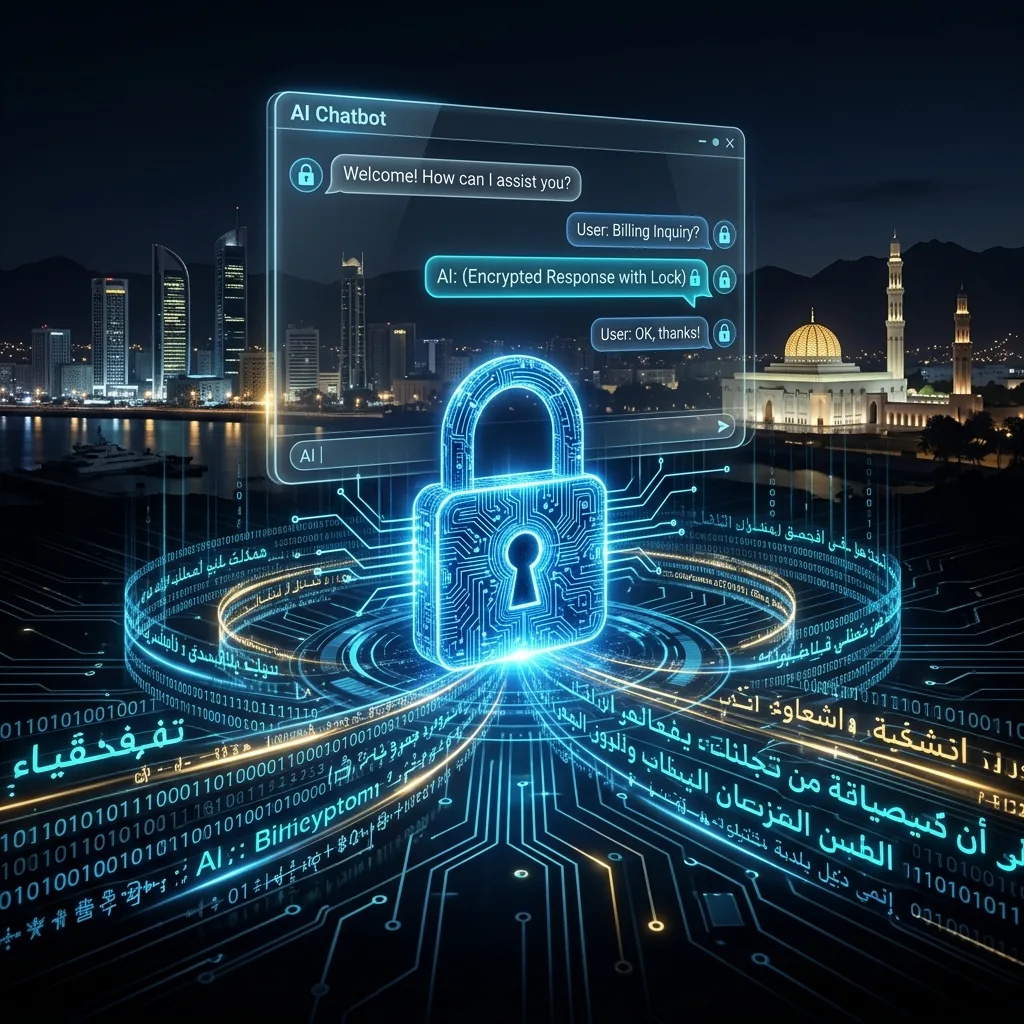
A telecom customer in Muscat opens a chat window at 11 p.m. to dispute a billing error. Within seconds, an AI-powered chatbot pulls up their account number, recent transaction history, and national ID fragment to verify identity. The entire exchange takes ninety seconds—but if any of that data travels unencrypted, the company faces fines of up to OMR 500,000 under Oman's Personal Data Protection Law. For businesses racing to deploy AI customer service across the Sultanate, encryption is no longer a "nice-to-have." It is the legal floor.
Why Does Unencrypted AI Customer Service Put Omani Businesses at Risk?
Unencrypted AI customer service exposes businesses to regulatory penalties, data breaches, and irreversible reputational damage under Oman's fully enforced PDPL. Every AI chatbot interaction generates data—names, phone numbers, billing details, location metadata—that qualifies as personal data under Royal Decree 6/2022. When that data flows between a customer's device and your AI backend without encryption, it becomes vulnerable to man-in-the-middle attacks, packet sniffing, and unauthorized interception.
The stakes in Oman are concrete. The Ministry of Transport, Communications and Information Technology (MTCIT) now requires organizations to report data breaches within 72 hours. A single intercepted chatbot conversation containing a customer's civil ID number could trigger mandatory disclosure, regulatory investigation, and penalties that reach seven figures in Omani Rials. In the banking sector, the Central Bank of Oman's Cyber Security & Resilience Framework (CS&RF) adds a second layer of obligation, requiring financial institutions to demonstrate encryption across all six of its security domains.
"If your AI chatbot handles even one customer's personal data without encryption, you are operating outside the law in Oman as of 2026."
What Encryption Standards Does Oman's PDPL Require for AI Chatbots?
Oman's PDPL requires organizations to implement "necessary technical and organizational measures" to protect personal data, which industry standards interpret as TLS 1.3 for data in transit and AES-256 for data at rest. The law itself does not prescribe a named algorithm—this is deliberate, ensuring the regulation remains technology-neutral as standards evolve. However, the Executive Regulations (Ministerial Decision 34/2024) and the MTCIT's published guidance make clear that the standard of care is measured against current best practice.
Here is the practical breakdown for a Muscat-based business deploying an AI chatbot:
Encryption in Transit: TLS 1.3
Every message between a customer's browser or WhatsApp client and your AI server must travel through a TLS 1.3 (or higher) encrypted tunnel. TLS 1.3 eliminates vulnerable cipher suites present in older versions, reduces handshake latency by 33%, and supports perfect forward secrecy by default. For businesses in Oman using the WhatsApp Business API, the platform itself provides end-to-end encryption between users and WhatsApp servers—but the critical gap occurs when messages land on your AI processing backend.
Encryption at Rest: AES-256
Conversation logs, customer profiles, and any personal data stored in your databases must be encrypted using AES-256 or an equivalent standard. This means implementing column-level encryption for PII fields (names, national IDs, phone numbers), full-disk encryption on database servers, and a dedicated Key Management System (KMS) using Hardware Security Modules (HSMs). Encryption keys should be rotated every 90 days at minimum.
End-to-End Encryption (E2EE) for High-Sensitivity Sectors
For banks regulated by the CBO, healthcare providers handling patient data through AI triage bots, and government-adjacent entities in Muscat, end-to-end encryption ensures that not even the service provider can read the content of conversations. This is the gold standard recommended under the CBO's Digital Banking Framework, effective since June 2025.
How Can Omani Companies Implement Encryption in 5 Practical Steps?
To implement PDPL-compliant encryption for AI chatbots, Omani companies need to follow a structured five-step process covering certificates, key management, vendor contracts, monitoring, and staff training. Here is the step-by-step roadmap:
Step 1: Audit your current AI chatbot data flow. Map every point where customer data is created, transmitted, processed, and stored. Identify which data qualifies as personal data under the PDPL. A Salalah-based retail chain, for example, discovered that their chatbot was logging IP addresses and device fingerprints without encryption—data they had not classified as personal.
Step 2: Deploy TLS 1.3 certificates on all endpoints. Purchase wildcard SSL/TLS certificates from a trusted Certificate Authority and configure your web servers, API gateways, and WebSocket connections to enforce TLS 1.3. Disable all fallback to TLS 1.2 or lower. Cost: approximately USD 150–300/year for enterprise-grade certificates.
Step 3: Implement AES-256 encryption at the database layer. Use your cloud provider's native encryption (AWS KMS, Azure Key Vault, or Omantel's otech sovereign cloud encryption services) to encrypt conversation logs at rest. For businesses hosting on-premises in Sohar or Muscat, deploy open-source tools like HashiCorp Vault for key management.
Step 4: Sign Data Processing Agreements (DPAs) with all vendors. If you use a third-party AI provider (OpenAI, Google Cloud AI, or a regional vendor), your DPA must specify where data is processed, what encryption standards apply, and how breach notifications flow. Under the PDPL, the data controller—your business—bears ultimate liability.
Step 5: Schedule quarterly encryption audits. Conduct penetration testing focused on your AI chatbot's API surface, validate certificate expiration dates, test key rotation procedures, and document everything. The CBO's CS&RF framework recommends continuous monitoring for financial institutions, with formal third-party audits at least twice per year.
How Does Data Sovereignty Affect AI Chatbot Encryption in the GCC?
Data sovereignty in the GCC directly determines where your encrypted AI chatbot data can physically reside, with Oman, Saudi Arabia, and the UAE each imposing localization requirements that affect encryption architecture. Under Oman's PDPL, transferring sensitive personal data outside the Sultanate requires prior approval from the Cyber Defence Centre. This means that an AI chatbot processing customer queries for a Muscat bank cannot simply route data through a US-based cloud region—even if that data is encrypted.
The practical solution is to host your AI processing within Oman's borders. Omantel's otech sovereign cloud provides locally hosted infrastructure with built-in encryption services that satisfy both the PDPL and the CBO's framework. For businesses operating across multiple GCC states, national AI initiatives like Oman's Maeen and Saudi Arabia's equivalents allow you to process Arabic-language customer queries locally, eliminating cross-border transfer risks entirely while preserving Vision 2040 digital economy alignment.
What Happens If an Encrypted AI Chatbot Still Gets Breached?
Even with encryption, an AI chatbot can be breached through prompt injection attacks, compromised API keys, or insider threats—making incident response planning a legal requirement, not just a best practice. Encryption protects data confidentiality, but it does not prevent all attack vectors. In 2025, a GCC-based financial services firm experienced a breach when attackers exploited a prompt injection vulnerability to extract customer data through the AI model's response stream, bypassing database-level encryption entirely.
Under the PDPL, you must notify the MTCIT within 72 hours of discovering a breach. Your incident response plan should include: immediate isolation of the compromised AI service, forensic analysis of encrypted logs (this is where proper KMS architecture pays off—you can decrypt specific logs for investigation without exposing the entire database), customer notification within the regulatory timeline, and a root-cause remediation report filed with the relevant authority. For CBO-regulated entities, the timeline is even tighter, and the Central Bank expects real-time dashboards monitoring API traffic anomalies on your AI endpoints.