
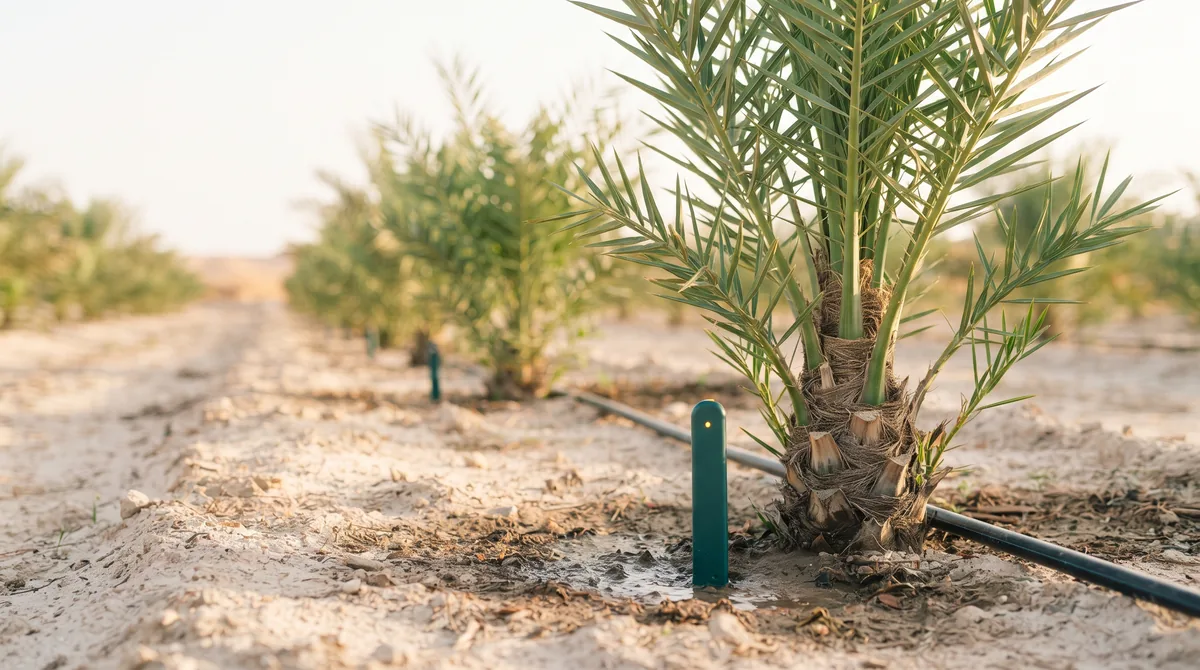
Walk through a date farm in Al Batinah at midday and you will usually find the same routine: the pump runs on a timer set years ago, the basins flood, and nobody knows how much of that water reaches the roots and how much evaporates or sinks past them. When the harvest comes in light, the explanation is "the heat", "the water was salty this year", or "the weevil". All three are real. None of them was measured while there was still time to act.
That gap between what is happening in the soil and what the farmer knows about it is where sensors and automation earn their keep. This guide covers what the numbers say, what AI actually adds, and how a farm or agribusiness in Oman can test it on one plot before spending serious money.
Why is water, not land, the real limit on Omani crop yields?
Water is the limit because agriculture already takes most of Oman's supply, much of it through flood irrigation, and over-pumping is pushing salt into the wells. More land does not help when there is no clean water to put on it.
The numbers are stark. An IWMI report on groundwater use in Oman, citing ministry officials, puts agriculture at roughly 78–83% of the country's water supply. The same report notes that the Batinah plains provide about 60% of Oman's agricultural production, and that rising salinity has taken more than 30% of agricultural land out of future production.
The report also cites a 2012 ICBA survey finding that only 15% of date palms and other fruit trees were watered with modern systems such as drip or sprinklers; surface flooding was still the norm. Adoption has grown since, but the lesson holds: when every farm pumps the same aquifer, water wasted on one plot shows up as salt in the neighbour's well a few years later.
How do soil sensors increase crop yields?
Soil sensors increase yields by watering to the plant's real need instead of a fixed timer, so roots are never waterlogged or drought-stressed. The same sensors usually cut water use sharply at the same time.
The clearest Gulf evidence comes from date palms, the crop that matters most in Oman. A 2021 trial at the Date Palm Research Center of Excellence, King Faisal University, published in the journal Sensors, compared traditional surface irrigation with an IoT-controlled subsurface system that switched water on and off based on soil moisture readings:
| Measure (date palm, Saudi trial) | Traditional surface irrigation | Sensor-based irrigation | Difference |
|---|---|---|---|
| Irrigation water applied | Baseline | 64.1% less | −64.1% |
| Yield per tree | 30.97 kg | 37.57 kg | +21.3% |
| Water productivity | 0.531 kg/m³ | 1.783 kg/m³ | 3.4x |
Two cautions before anyone quotes that table to a bank. First, it is one trial, on one farm, with a subsurface system; your soil, variety and water quality will move the result. Second, a simpler time-based schedule on the same system saved 61.2% of water, so much of the gain came from replacing flooding at all. The sensor's job is to keep that schedule right as the season, the heat and the salt change.
What does AI add on top of the sensors?
AI adds judgement: it combines sensor readings with weather forecasts and history to decide what to do next, and it spots patterns a person would miss. Sensors alone just produce numbers nobody has time to read.
In practice, a useful system does four things:
- Schedules irrigation. Soil moisture, temperature and the forecast feed a model that decides tonight's watering, plot by plot.
- Watches salt. Salinity probes show when salt is building in the root zone, so the farm can time a leaching cycle before leaves burn.
- Catches pests early. Red palm weevil larvae eat a palm from the inside, silently. A 2020 KAUST study in Scientific Reports used a fibre-optic acoustic sensor and machine learning to detect larvae as young as 12 days, and estimated one fibre could monitor around 1,000 palms. The same paper notes Gulf countries spend about $8 million a year just removing infested trees.
- Flags equipment trouble. A moisture reading that stays flat while the pump log says it ran usually means a blocked line or a failing pump. The logic is the same as the predictive maintenance used in Oman's oil and gas sector, applied to a farm.
The part most projects get wrong is the last metre: getting the answer to the person who has to act. A dashboard nobody opens changes nothing. A WhatsApp message to the farm manager that says "Plot 3 is dry at root depth, no rain forecast, irrigate tonight" gets done.
AI Profit Lab is built by an engineer who has designed and run a real distribution business. The lesson carries straight over to farms: the system that wins is the one the team actually reads at 5am, not the one with the most sensors.
How should an Omani farm start with smart agriculture?
To start, you need one clear question, one test plot and one full season of data. Buying sensors for the whole farm first is the most common and most expensive mistake.
A sensible first season looks like this:
- Pick the question. For example, "are we over-watering the Khalas palms?" or "is the well getting saltier?".
- Split one plot. Put moisture and salinity probes on half and leave the other half on today's routine as a control.
- Automate the reporting, not the pump. Send readings to a simple dashboard and a daily WhatsApp summary. Let people act on the advice before you let software open valves.
- Measure water and harvest weight on both halves. After one season you have your own numbers, not a brochure's.
You will not be starting alone. According to the Oman Observer, the Ministry of Agriculture, Fisheries and Water Resources is running smart-agriculture pilots in Al Batinah North, Al Batinah South and Dhofar, with an Agriculture Innovation Centre in Sohar. That work lines up with Oman Vision 2040's priorities of food security and sustainable resource use; we covered how businesses can align automation projects with Vision 2040 separately.
For an agribusiness or a distributor of farm inputs, the same approach applies to the office side: orders from farms, delivery schedules and stock of fertiliser and drip parts. If you are not sure where automation would pay first, an AI opportunity audit is the place to start.