

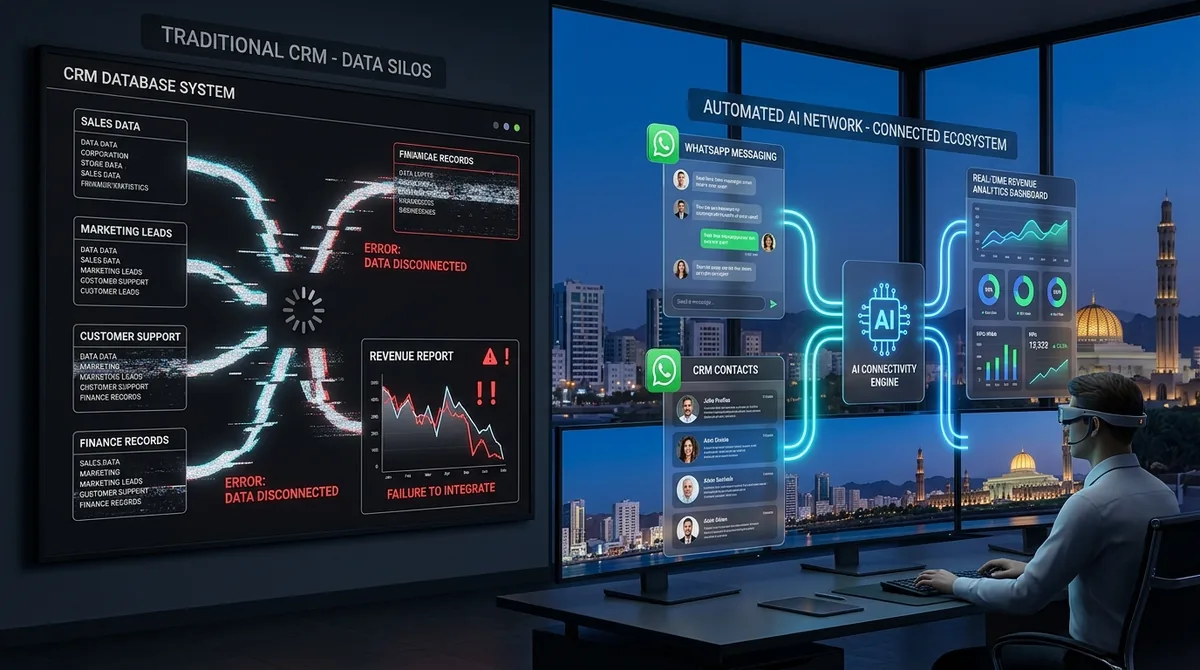
Every year, growing enterprises across Muscat, Sohar, and Salalah invest tens of thousands of Omani Rials into world-class Customer Relationship Management (CRM) platforms like Salesforce, HubSpot, or Zoho. Executive leadership anticipates streamlined pipelines, accurate revenue forecasting, and transparent team performance metrics. Yet, within 6 months of implementation, over 70% of traditional CRM implementations in the GCC collapse into expensive digital filing cabinets filled with outdated contact numbers, missing deal stages, and untracked customer conversations.
The root cause is not software quality; it is human operational friction. In fast-moving Gulf business environments, forcing sales executives to manually log call notes, copy customer details from phone screens, and update pipeline status cards creates a massive administrative burden. When sales representatives spend over 4.2 hours per day on repetitive manual reporting, CRM compliance plummets. To maintain accurate records without draining executive productivity, companies are implementing automated internal operations pipelines that log interaction data directly from primary communication channels.
Why Do Omani Businesses Struggle with Manual CRM Data Entry?
Omani businesses struggle with manual CRM data entry because sales representatives view manual logging as an administrative tax that reduces active selling time. Without automated AI extraction, CRM records quickly become incomplete and inaccurate.
Traditional CRMs were architected for Western desktop-first work environments where employees spend their day inside email clients and web browsers. In Oman, however, business relationships thrive on rapid mobile communication, direct phone calls, and face-to-face meetings along commercial districts like Wattayah and Azaiba. When sales managers require reps to return to the office and manually type notes into desktop software, critical prospect details are forgotten or omitted.
The Hidden Costs of Legacy CRM Breakdown in Oman
- Incomplete Lead Dossiers: 64% of CRM records lack key decision-maker titles, budget parameters, or target decision dates.
- High Administrative Overhead: Sales reps waste up to 35% of their working hours manually copying lead details from spreadsheets and mobile devices.
- Inaccurate Sales Forecasting: Department leaders rely on stale pipeline data, resulting in revenue projection errors exceeding 25%.
- Data Vulnerability & Attrition: When a sales representative leaves the firm, proprietary deal context stored only on personal mobile devices disappears.
Relying on manual compliance to maintain database hygiene is a losing battle. Enterprise growth requires shifting from manual data entry to background AI data capture workflows that log conversations autonomously.
How Does Disconnected WhatsApp Messaging Kill Omani Customer Retention?
Disconnected WhatsApp messaging kills Omani customer retention by isolating primary customer conversations from central CRM databases. When prospects message on WhatsApp and reps fail to sync records, deals stall and customer trust degrades.
WhatsApp is the undisputed backbone of business communications in Oman. From retail quotes and real estate inquiries to enterprise consulting agreements, Omani clients expect instant conversational updates on WhatsApp rather than formal email threads. However, standard CRM systems cannot natively parse, summarize, or index localized WhatsApp chats without specialized middleware.
When an inbound lead contacts a company on WhatsApp at 9:00 PM, a traditional setup relies on a human agent seeing the notification the next morning. If the lead is assigned to a rep's personal phone, management has zero visibility into whether the prospect received a quote or was ignored. Deploying autonomous AI qualification agents solves this gap by capturing incoming inquiries, conducting instant screening in Arabic or English, and pushing rich interaction summaries directly into central CRM pipelines.
"A CRM that does not automatically capture WhatsApp interactions in Oman is not a management system—it is merely a list of names with missing histories."
How Can AI Automation Transform Static CRMs into Revenue Engines in Muscat?
AI automation transforms static CRMs into revenue engines by introducing automated webhooks, natural language parsing, and predictive lead routing. AI agents capture conversations, update deal stages, and trigger timely follow-ups without manual rep intervention.
Instead of treating the CRM as a passive database that reps must update, AI automation turns it into an active operational engine. When a prospect engages via web chat, email, or WhatsApp, an intelligent middleware layer automatically performs four core functions:
- Real-Time Profile Creation: Extracts client names, company entities, phone numbers, and inquiry parameters, creating structured CRM contacts in seconds.
- Sentiment & Intent Analysis: Evaluates buyer urgency and assigns objective lead scores, prioritizing high-value opportunities for immediate executive outreach.
- Automated Task Dispatching: Assigns follow-up tasks to account executives, generates localized quotation drafts, and schedules calendar reminders.
- Executive Dashboard Synchronization: Streams consolidated pipeline metrics directly to real-time CEO dashboards, eliminating manual weekly reporting meetings.
| Metric / Dimension | Traditional Legacy CRM Setup | AI-Automated CRM Ecosystem |
|---|---|---|
| Data Logging Velocity | Delayed (12 to 48 Hours) | Instantaneous (< 5 Seconds) |
| Rep Time Spent on Admin | 3.5 – 4.2 Hours / Day | Under 25 Minutes / Day |
| WhatsApp Integration | Disconnected / Manual Copy-Paste | Fully Automated Bi-Directional Sync |
| Pipeline Data Accuracy | 30% – 45% (Human Error & Omissions) | > 98% Verified Systemic Accuracy |
| Oman PDPL Compliance | High Risk (Unencrypted Rep Phones) | Fully Encrypted Data Residency Logs |
By automating the data lifecycle, Omani business leaders transform their CRMs from neglected expenses into high-margin revenue drivers that empower sales teams to close deals faster.