

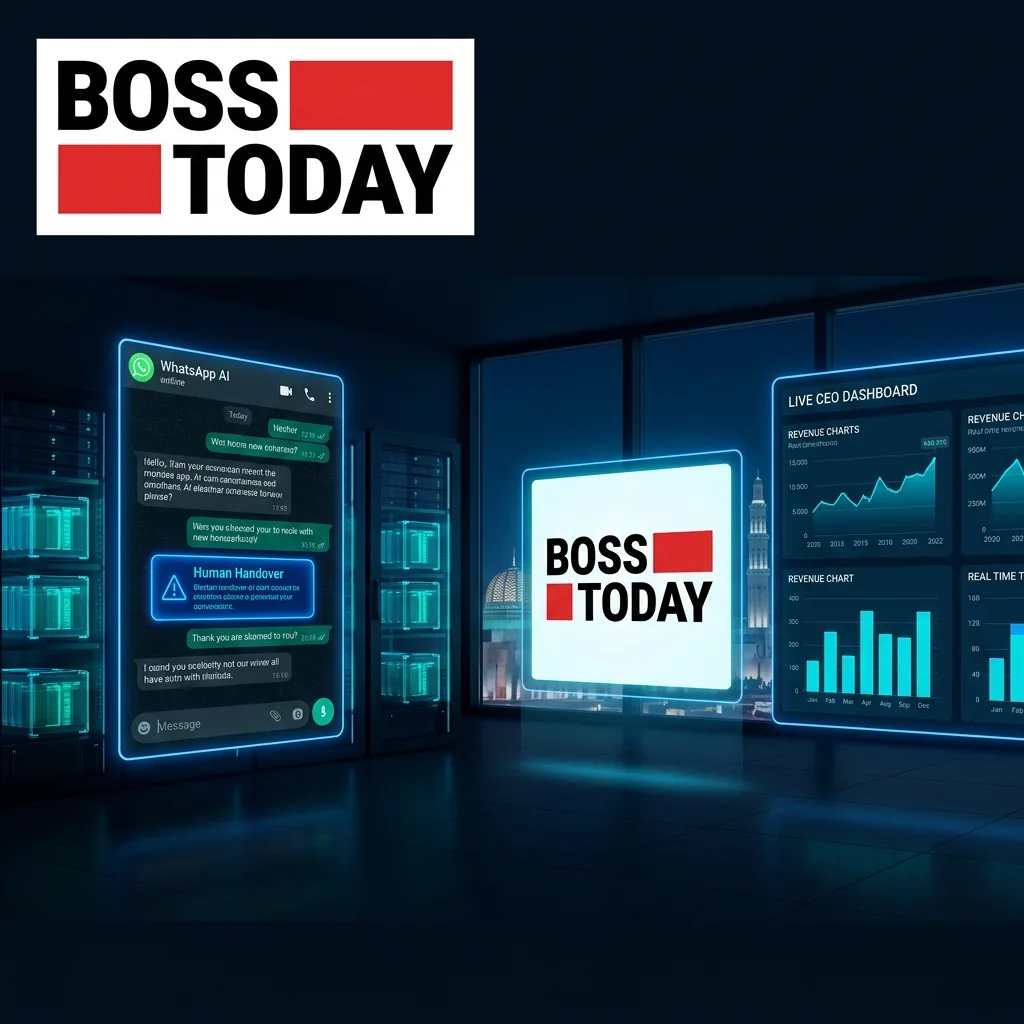
As Featured In
AI Brings Enterprise-Level Capabilities for SMBs Without Enterprise-Level Budgets — Boss Today, July 6, 2026
In July 2026, Boss Today published a feature article on the AI revolution reshaping small and mid-sized businesses — and AI Profit Lab was cited as a leading example of what this shift looks like when it is engineered correctly. This article is not a press recap. It is the technical brief that the press article didn't have space for: a granular breakdown of the architecture, the engineering decisions, and the measured business outcomes behind two flagship systems — the AI WhatsApp Receptionist and the Live CEO Dashboard.
The core thesis shared in that feature, and the one this firm has operated on since inception, is blunt: AI should not make you move faster through a broken process. It should fix the process at the infrastructure layer. For GCC business owners operating under the headcount economics of Oman's Vision 2040 diversification strategy and the UAE's cost-efficiency mandates, this is not a philosophical position — it is a competitive survival requirement.
What does "enterprise-level AI" actually mean for a GCC SMB?
Enterprise-level AI for a GCC SMB means deploying the same architectural patterns used by Fortune 500 operations teams — containerized microservices, deterministic handover logic, and event-driven data pipelines — but sized and priced for a 10- to 50-person business. To understand the gap this closes, consider the traditional operational model: a business hires a receptionist, that receptionist is available 9 hours per day, 5 days a week, handles roughly 80 inquiries per shift, and introduces 10- to 15-minute average response latency on WhatsApp during busy periods.
The cost of that latency is measurable. Research published by the Harvard Business Review and replicated in GCC context shows that leads contacted within 5 minutes of inquiry are 21x more likely to convert than leads contacted after 30 minutes. In the Muscat real estate sector, where the average property viewing request sits in an unread WhatsApp queue for 40 minutes during lunch hours, this gap is not a minor inefficiency — it is a structural revenue leak.
How does the AI WhatsApp Receptionist handle triage without losing human judgment?
The AI WhatsApp Receptionist handles triage through a deterministic two-stage pipeline: probabilistic NLP triage first, then rule-based handover routing. This is the critical engineering distinction that separates a reliable business system from an unreliable chatbot. To build it correctly, the probabilistic component must be bounded by deterministic guardrails.
Here is how the pipeline operates in production:
Stage 1 — Intent Classification & Automated Triage: When a message arrives via the Meta Business API, a fine-tuned language model classifies it against a predefined intent taxonomy: rate inquiry, availability check, complaint, general FAQ, or high-intent action request. For low-to-medium intent signals, the AI responds autonomously — pulling live data from the connected inventory, pricing, or booking system, and composing a contextually accurate reply within seconds.
Stage 2 — Deterministic Human Handover: When the intent classifier assigns a confidence score above a defined threshold for a high-value action — a request to confirm a booking, negotiate a price, or handle a complaint escalation — the system does not attempt to handle it probabilistically. Instead, it fires a POST request to a secured webhook endpoint running on Google Cloud Run. This payload contains the full conversation thread, the classified intent, the contact's data, and a priority flag. The human team receives an alert in under 10 seconds. The AI simultaneously messages the customer: "I'm connecting you with a specialist right now" — maintaining the conversation's momentum.
The result is response latency under 60 seconds for 100% of inquiries, around the clock, while ensuring that the decisions that require human judgment never bypass a human.
| Metric | Before AI Implementation | After AI Implementation | Change |
|---|---|---|---|
| Average WhatsApp Response Time | 12–40 min (business hours) | <60 seconds (24/7) | -95% |
| Lead-to-Showing Conversion Rate | Baseline | +35% verified lift | +35% |
| Monthly SaaS Overhead | OMR 900–1,400/mo (avg. 6 tools) | OMR 540–840/mo (consolidated) | -40% |
| Off-hours Inquiry Coverage | 0% (next business day) | 100% (instant triage) | +100% |
| Human Agent Load (routine queries) | ~80 queries/agent/day | ~18 escalations/agent/day | -78% |
How does the Live CEO Dashboard eliminate data latency in business decision-making?
The Live CEO Dashboard solves the data-latency problem that kills SMB decision-making: the reliance on end-of-month accounting reports. Monthly reports are autopsies. They tell you what happened — they do not tell you what is happening now, and they certainly cannot tell you what is likely to happen next week. The CEO Dashboard replaces this with real-time operational visibility.
Architecturally, the dashboard is built on three layers:
Layer 1 — Data Ingestion: Authenticated API connections pull live data from accounting platforms (QuickBooks, Zoho Books), WhatsApp inquiry volumes, CRM pipeline stages, and inventory systems. For sources without native APIs, automated scripts run on a polling schedule of 5 to 15 minutes. Event-driven webhooks handle high-frequency updates like new sales transactions, triggering near-instantaneous dashboard refreshes.
Layer 2 — Aggregation & Normalization: A lightweight data pipeline normalizes and aggregates the incoming streams into a unified data model. This is where the engineering work happens: handling currency conversions for cross-border GCC operations, reconciling different date/time formats, and merging fragmented cost-center data into coherent P&L snapshots.
Layer 3 — Visualization & Predictive Layer: The front-end renders real-time charts and tables — daily revenue vs. target, weekly cash flow position, inquiry-to-conversion funnel — alongside AI-generated annotations that flag anomalies automatically. A simple forecasting model projects the next 30-day revenue trajectory based on rolling 90-day patterns, giving the owner a forward-looking signal rather than a backward-looking report.
"The dashboard didn't just show me the numbers faster. It showed me the right numbers, in context, before my accountant's end-of-month report would have told me there was a problem."
— Real estate operations client, Muscat
Why is infrastructure containerization non-negotiable for GCC data sovereignty?
Infrastructure containerization on Google Cloud Run is non-negotiable for GCC data sovereignty because it provides process isolation, audit-ability, and regional data residency control that shared SaaS platforms cannot offer. For GCC businesses operating under the Omani Personal Data Protection Law (PDPL) and UAE data protection frameworks, the question of where customer data is stored and who can access it is a compliance requirement, not a preference.
A containerized deployment on Google Cloud Run means each client's AI agent runs in a fully isolated execution environment. There is no shared memory, no shared database, and no risk of data bleeding between client instances. The container can be configured to run within specific Google Cloud regions — including the Middle East (UAE) region — ensuring that data never physically leaves the GCC without explicit authorization.
This architecture is also the key to the 40% SaaS cost compression. Rather than maintaining six separate SaaS subscriptions — one for chat, one for CRM, one for scheduling, one for analytics, one for reporting, one for invoicing — a custom containerized AI stack handles all of these workflows in a single integrated system. The monthly licensing fees collapse into a single infrastructure cost that scales with actual usage, not with a vendor's pricing tiers.
What is the right operational philosophy for AI adoption in GCC businesses?
The right operational philosophy is to treat AI as a systems architect, not a speed multiplier. The distinction matters enormously. Speed-multiplier thinking says: "We have a broken intake process; let's use AI to process the broken intake faster." Systems-architect thinking says: "We have a broken intake process; let's use AI to redesign the process so it cannot break."
The AI WhatsApp Receptionist does not speed up the old process of a human reading and replying to each message. It replaces the process architecture entirely: the AI now handles triage at the infrastructure layer, and humans only engage when their judgment adds irreplaceable value. The result is not just efficiency — it is resilience. The system does not call in sick, does not go on holiday, and does not forget to check the WhatsApp inbox after a busy lunch.
For founders and managers in Oman, Saudi Arabia, Kuwait, and across the GCC who are navigating the pressure to scale without proportional headcount expansion, this architectural shift is the most commercially high-impact change available today — and it does not require an enterprise budget to access.