

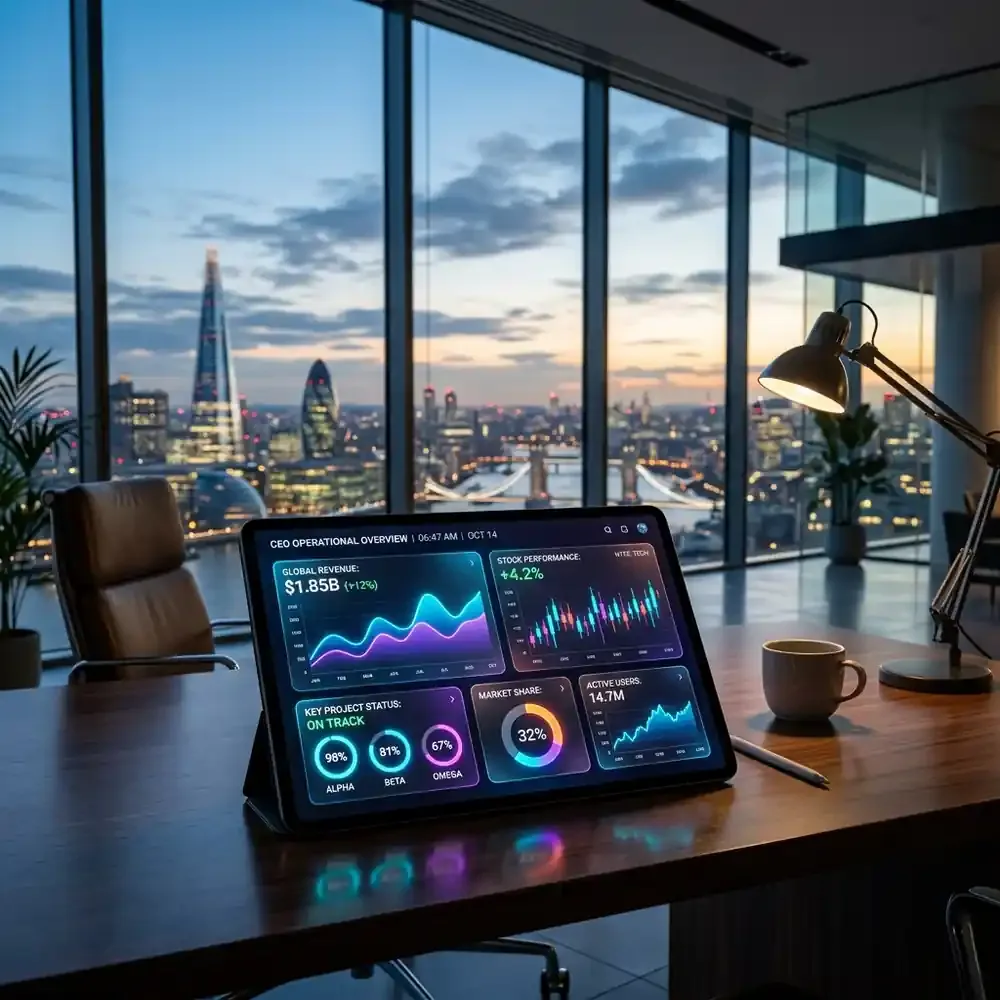
It's 6:00 AM on a Tuesday. The CEO of a mid-sized tech firm doesn't reach for a stack of printed reports, nor do they frantically email the IT department for a data export. Instead, they glance at their tablet. Instantly, an AI-powered pulse of their entire company materializes. A subtle red glow highlights an unexpected dip in European supply chain efficiency over the last 12 hours, paired immediately with a plain-language summary: "Supplier delay in Frankfurt. Recommend shifting 15% of orders to the Madrid hub."
This is the reality of executive leadership in 2026. The era of the passive, retrospective spreadsheet is dead. In its place, the customized CEO dashboard has evolved into an active, intelligent copilot. It’s no longer just about seeing the data; it’s about touching the nervous system of an enterprise.
The Death of the Monthly Report
For decades, the standard executive reporting tool was a sprawling, static document that told a leader what happened last month. But a modern business moves too fast for history lessons. Today's trend is the decision surface—a high-level command center built around exception-first reporting.
Rather than drowning leaders in a sea of green checkmarks and expected outcomes, this new breed of customized CEO dashboard is designed to hunt anomalies. It filters out the operational noise, aggressively highlighting only the critical gaps, sudden spikes, and strategic risks. This shift radically reduces decision fatigue. A CEO logs on, immediately sees what requires their unique strategic intervention, and ignores the rest.
Enter the AI Copilot
The most dramatic shift in 2026 is the integration of Natural Language Processing (NLP) into dashboard interfaces. A customized CEO dashboard is no longer a tool you simply read; it’s a tool you talk to.
Executives can now ask their dashboards plain-language questions: "Why did our Q2 retention drop in the enterprise sector?" The AI instantly cross-references CRM data, finance records, and HR outputs to generate unified insights. This seamless, real-time data integration provides a true 360-degree view without requiring a panicked late-night call to a data analyst.
Empowerment Through No-Code Customization
The power dynamic between IT and the C-Suite has shifted. Historically, if a CEO wanted a new metric tracked, it meant submitting a ticket to the development team and waiting weeks. Today, the movement is fiercely toward self-service and low-code/no-code environments.
Leaders or their immediate staff can now build, modify, and reorganize their custom dashboards on the fly as strategic priorities shift. If a new market opportunity opens up, the dashboard adapts in minutes, not months.
From Reactive to Prescriptive
The true magic of the 2026 customized CEO dashboard isn't just showing what is happening right now; it's predicting what will happen next. By integrating predictive analytics, these systems forecast trends, run scenario analyses, and offer prescriptive recommendations. They empower leaders to shift from reactive troubleshooting—putting out fires—to proactive, visionary planning.
And because executive decision-making rarely happens solely at a desk, these platforms are rigorously designed for a mobile-first world. Whether in an airport lounge, the back of a black car, or during a board meeting, the same high-level insights remain right at their fingertips.