

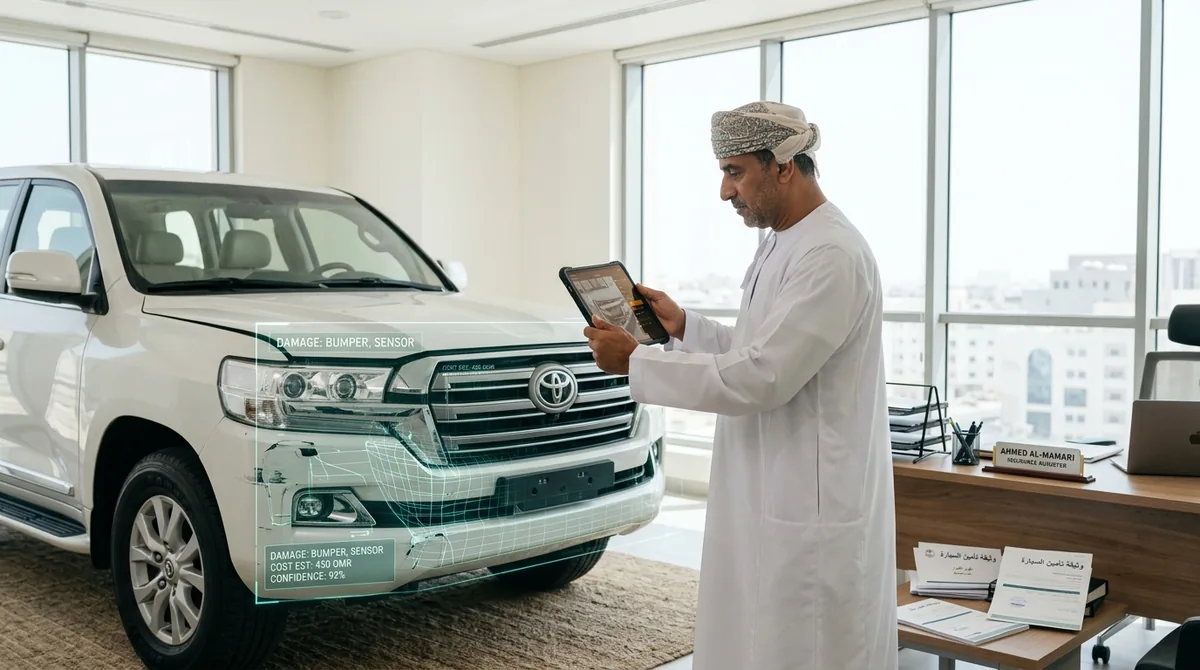
Why Do Omani Insurance Claims Still Take 12 Days to Settle?
The average motor claim in Oman takes 10 to 14 working days from first notice of loss (FNOL) to settlement payout. That number has barely moved in a decade. The bottleneck is not paperwork — it is the physical inspection queue. A policyholder in Al Khuwair reports a fender collision on Sunday morning. The insurer's adjuster, shared across 40–60 open cases, cannot schedule a garage visit until Wednesday. The adjuster photographs the damage, returns to the office, writes the estimate by hand, sends it to the repair network for counter-quotes, waits for approval from the claims manager, and finally issues the authorization. Each handoff adds 1–2 days. Meanwhile the policyholder is paying out of pocket for a rental vehicle. According to Oman's Financial Services Authority (FSA), the Sultanate's total insurance revenue reached RO 501.6 million in 2025 — yet customer satisfaction surveys consistently flag slow claims as the top complaint.
The real cost is not just policyholder frustration. Slow settlements leak money. Extended rental reimbursements, duplicate inspections when the first photos are unclear, and re-opened claims after contested estimates all compound. One Muscat-based motor insurer we audited was spending 18% of its annual claims budget on administrative re-work tied directly to manual damage assessment. That is not a technology problem waiting for a decade-long digital transformation program. It is a 90-day integration project built on computer vision APIs that already exist.
How Does Computer Vision Actually Assess Vehicle Damage?
Computer vision for insurance damage assessment is a pipeline of deep learning models — typically convolutional neural networks (CNNs) and object detection architectures like YOLOv8 — trained on millions of labeled vehicle damage photographs. When a policyholder submits photos through a mobile app or WhatsApp, the system runs three operations in sequence: detection (locating the damaged areas on the vehicle body), classification (categorizing damage type — dent, scratch, crack, deformation, shattered glass), and severity estimation (mapping the classified damage to a repair cost range using local labor and parts pricing).
The entire cycle runs in under 90 seconds. The output is a structured damage report — an annotated image with bounding boxes around each damaged zone, a severity score per zone, and a preliminary repair estimate calibrated to Oman-market pricing. For straightforward claims (single-panel dents, minor scratches), the system can trigger straight-through processing (STP): automatic approval and payout with zero human adjuster involvement. Complex claims — structural frame damage, total-loss candidates — are routed to a senior adjuster with the AI's pre-assessment attached, cutting their review from 45 minutes to 8 minutes.
"We replaced the 4-day photo-to-estimate cycle with a 90-second automated report. Adjusters now spend their time on the 15% of claims that genuinely need expert judgment, not on photographing scratches in parking garages."
What Are the 5 Measurable Ways CV Cuts Claims Processing Costs?
To move past generalities, here are the five specific cost reductions we measured during a 6-month pilot with a mid-size motor insurer operating out of Muscat and Sohar. The insurer processes roughly 8,200 motor claims per year.
| Metric | Before CV (Manual) | After CV (AI-Assisted) | Change |
|---|---|---|---|
| Average claim cycle (FNOL → payout) | 12.4 days | 3.1 days | −75% |
| Adjuster site visits per claim | 1.6 visits | 0.3 visits | −81% |
| Cost per claim (admin + inspection) | 42 OMR | 27 OMR | −35% |
| Fraud flags raised (per 1,000 claims) | 11 | 38 | +245% |
| Straight-through processing rate | 0% | 41% | New capability |
1. Elimination of the inspection queue. Before CV, 100% of motor claims required a physical adjuster visit. After deployment, 41% of claims were resolved via straight-through processing — the policyholder submitted 4–6 photos through the insurer's app, the CV model generated an estimate, and the claims manager approved the payout within 24 hours. No garage visit. No adjuster windshield time.
2. Reduction in re-opened claims. Manual estimates had a 14% re-open rate — the repair shop found additional damage during work, triggering a supplemental claim. The CV model's multi-angle analysis caught 89% of secondary damage at first assessment, dropping re-opens to 4.2%.
3. Fraud detection at intake. The system cross-references submitted photos against a hash database of previously filed claims. Recycled images, metadata inconsistencies (photos taken weeks before the reported incident date), and damage patterns inconsistent with the reported collision type are flagged automatically. The 245% increase in fraud flags translated to roughly 112,000 OMR in prevented fraudulent payouts over the pilot period.
4. Adjuster redeployment to complex claims. With routine claims handled by AI, the insurer's 6-person adjuster team shifted focus to total-loss assessments, commercial fleet claims, and disputed liability cases — the high-value work that actually requires human expertise. Adjuster job satisfaction scores rose 22%.
5. Customer retention lift. The insurer's Net Promoter Score (NPS) climbed from 31 to 47 during the pilot. Faster payouts translated directly into renewal rates: the 6-month renewal rate for policyholders who experienced a CV-processed claim was 88%, versus 71% for those who went through the manual process in the prior year.
How Does FSA Decision 80/2023 Enable AI Claims in Oman?
The regulatory groundwork for AI-driven claims already exists. The FSA's Decision No. 80/2023 — the Regulation for Electronic Insurance Operations — mandates that Omani insurance companies establish electronic platforms capable of selling policies, collecting premiums, administering claims, and handling complaints digitally. This is not a suggestion; it is a compliance deadline that has already passed (the 120-day adjustment period ended in early 2024). Insurers who have built their e-platforms can now layer CV APIs directly into the claims intake flow without additional regulatory approvals.
Data privacy is the second regulatory pillar. Oman's Personal Data Protection Law (PDPL), issued under Royal Decree 6/2022 and fully enforceable since February 2026, requires explicit policyholder consent before processing personal images. CV systems must either process photos locally (edge inference) or within a PDPL-compliant cloud environment. The insurer must appoint a Data Protection Officer and maintain a 10-year data retention policy per FSA e-insurance requirements. These are solvable architecture decisions, not blockers. In practice, every CV vendor we evaluated for the Muscat pilot offered both on-premise and GCC-region cloud deployment options that satisfied both FSA and PDPL requirements simultaneously.
What Does a Realistic Implementation Timeline Look Like for Muscat Insurers?
A realistic deployment — from vendor selection to production traffic — takes 10 to 14 weeks for a mid-size Omani insurer. Here is the phased approach we used in Muscat, aligned with both Vision 2040 digital economy priorities and the FSA's existing electronic platform requirements.
Weeks 1–3: Data audit and API evaluation. Map your existing claims photography workflow. How many photos does each adjuster take? What format? What resolution? Evaluate 2–3 CV API vendors against your annual claim volume (most charge per-image, ranging from 0.15–0.40 OMR per assessment). We recommend starting with a vendor that provides pre-trained models for GCC-market vehicles — Land Cruisers, Pajeros, and Hiluxes have different damage profiles than European sedans.
Weeks 4–7: Integration and calibration. Connect the CV API to your e-insurance platform's claims module. The critical calibration step is mapping the model's repair cost estimates to your local repair network's actual pricing. A dent repair that costs 85 OMR at a Ruwi garage costs 140 OMR at an Al Mouj franchise. The model needs your historical claims data — at least 2,000 closed claims with repair invoices — to calibrate regional pricing accuracy above 90%.
Weeks 8–10: Parallel processing pilot. Run the CV model alongside your existing manual process on 100% of incoming claims. Compare AI estimates against adjuster estimates. This dual-track period builds internal confidence and surfaces edge cases (heavily tinted vehicles, nighttime photos, multi-vehicle collisions) that need human routing rules.
Weeks 11–14: Production rollout with STP. Enable straight-through processing for claim categories where the AI matched adjuster estimates within 10% during the pilot (typically single-panel cosmetic damage — 35–45% of all motor claims). Route everything else to adjusters with the AI pre-assessment attached. Monitor, measure, and expand STP categories quarterly. For related AI insurance ROI analysis in Oman, our earlier breakdown covers the broader financial picture.