

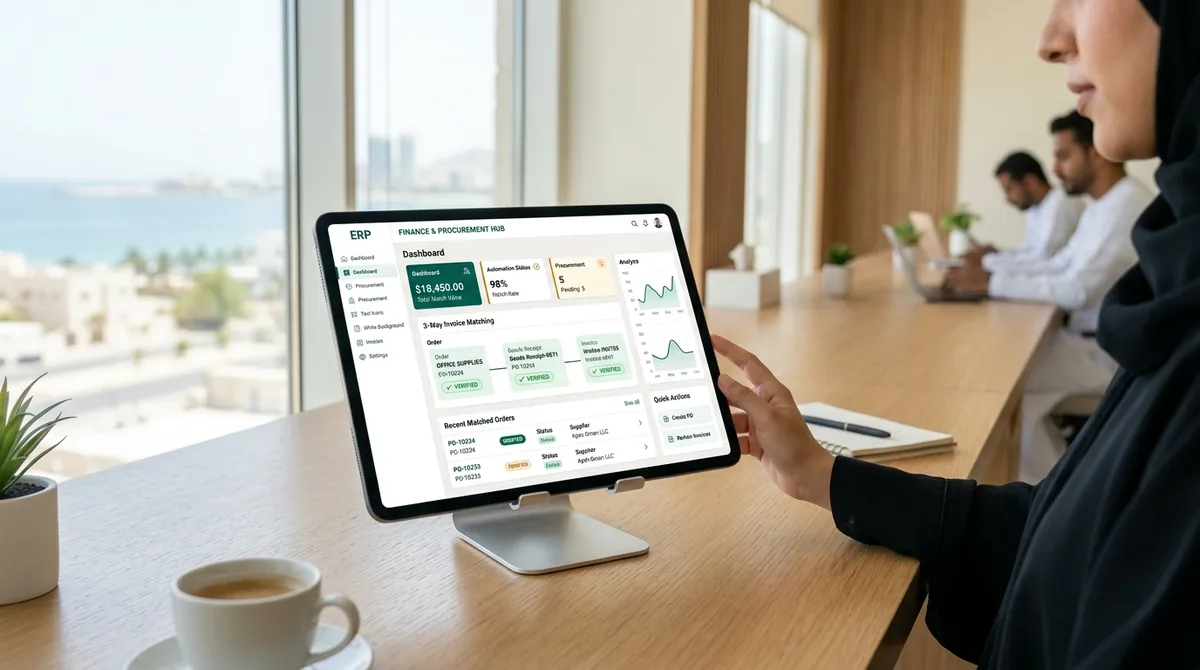
Accounting departments in Muscat and across the Sultanate of Oman face a silent margin killer: manual accounts payable processing. Every month, finance teams process thousands of supplier invoices arriving as scanned PDFs, WhatsApp attachments, and paper bills. Staff spend hours manually matching line-item descriptions, checking Goods Received Notes (GRNs), calculating 5% Omani Value Added Tax (VAT), and typing figures into systems like SAP S/4HANA, Oracle Fusion, or Odoo.
When procurement matching relies on manual human inspection, errors compound rapidly. Studies across GCC commercial operations indicate that 1 out of every 14 manually entered supplier invoices contains line-item variances, incorrect tax calculations, or duplicate payment requests. For a mid-sized distributor in Sohar handling 1,500 monthly vendor bills, manual matching costs over OMR 9,750 per month in direct labor overhead and delayed vendor discounts.
Why is manual 3-way invoice matching creating bottlenecks in Omani accounts payable departments?
Manual 3-way invoice matching causes severe operational friction in Omani finance teams due to disjointed paper trails, multi-language documents, complex VAT compliance, and slow approval workflows across purchase orders, warehouse receipts, and supplier invoices.
In standard procurement workflows, traditional accounts payable verification requires three distinct records to align perfectly before releasing supplier payments:
- Purchase Order (PO): Issued by procurement specifying authorized item quantities, agreed unit prices, and approved commercial terms.
- Goods Received Note (GRN): Issued by warehouse personnel in locations like Rusayl Industrial City or Salalah Free Zone confirming actual delivered quantities.
- Supplier Invoice: Sent by vendor requesting payment, including Tax Identification Numbers (TIN) and line-item totals.
When handled manually, matching these three documents requires accounts staff to open multiple screens, cross-check Arabic and English product descriptions, verify unit conversions (e.g., cartons versus individual units), and validate compliance with Oman Tax Authority (OTA) VAT rules. A single discrepancy—such as a 2% price inflation on raw materials or a missing GRN signature—stalls the entire batch, extending invoice processing timelines from 24 hours to 5 full working days.
How does AI-powered document extraction integrate directly with SAP, Oracle, and Odoo ERPs?
AI-powered invoice automation connects directly to your existing ERP database using intelligent vision OCR and automated workflow orchestrators to extract, validate, and post verified supplier transactions into accounts payable without manual intervention.
Modern enterprise automation builds combine optical character recognition (OCR) with advanced vision-LLM models trained on Arabic commercial typography and GCC invoice formats. Here is the step-by-step architecture that replaces manual data entry:
- Omnichannel Document Ingestion: Incoming invoices arriving via dedicated AP email inboxes, supplier portal uploads, or WhatsApp document channels are instantly picked up by automation webhooks built on tools like n8n workflow automation.
- Vision OCR & Field Extraction: Intelligent OCR engines parse both printed and handwritten Arabic text, line-item item codes, vendor bank details (IBAN), and 5% Omani VAT computations with over 99.2% field accuracy.
- Automated 3-Way Match Verification: The workflow queries your ERP database (via REST APIs or SQL database connectors) to pull the corresponding PO and GRN records. It compares line-item quantities and price tolerances automatically.
- GL Posting & Exception Routing: If the 3-way match passes within pre-set tolerances (e.g. zero price variance), the AI posts a draft journal entry directly into SAP or Odoo. If an anomaly is detected, an automated alert routes the flagged invoice to the procurement manager's Teams channel for a one-click human review.
This automated loop ensures that finance managers retain total control while stripping out 94% of repetitive manual data entry. Furthermore, by adhering to Omani Data Protection Law (PDPL) guidelines, local self-hosted or localized cloud deployment models safeguard sensitive enterprise accounting data.
Comparative Analysis: Manual Matching vs. Automated AI 3-Way ERP Matching
| Metric / Operational Parameter | Legacy Manual AP Workflow | Automated AI 3-Way ERP Matching |
|---|---|---|
| Average Processing Time per Invoice | 25 – 40 minutes per document | Under 45 seconds |
| Estimated Cost per Processed Invoice | OMR 6.500 (labor & overhead) | OMR 1.800 (72% cost reduction) |
| Line-Item Data Entry Error Rate | 7.1% (typos, wrong VAT, mismatched units) | Less than 0.3% |
| Duplicate Payment Prevention | Manual review (frequently missed) | Instant cryptographic hash matching |
| ERP Integration Compatibility | Manual keystrokes into legacy screens | Native REST API / SQL / Webhooks |
What ROI and operational savings can Omani businesses expect from procurement automation?
Omani enterprises deploying automated invoice processing achieve full capital payback within 60 to 90 days, realizing a 72% reduction in accounts payable operational costs and unlocking valuable early-payment vendor discounts.
Consider a practical Muscat manufacturing business handling 2,000 invoices monthly. Under legacy manual operations, employing 4 full-time AP clerks costs approximately OMR 3,200 monthly in direct salaries, office space, and software licenses, yielding an average cost of OMR 1.600 per invoice. In addition, delayed payments frequently incur vendor late fees or forfeits early-payment discounts of 2% to 3%.
By implementing automated 3-way matching integrated with an ERP platform like Odoo Enterprise or SAP S/4HANA:
- Direct Staff Re-allocation: AP staff reduce time spent on manual typing by 85%, shifting their focus toward strategic procurement, vendor contract negotiation, and treasury management.
- Early Payment Discount Capture: Processing invoices within 15 minutes enables finance teams to capture vendor early-payment discounts, generating over OMR 4,500 in direct annual treasury savings.
- Oman Tax Compliance Assurance: Automated 5% VAT audit checks eliminate penalties associated with incorrect input tax claims during Oman Vision 2040 digital compliance reviews.
To learn how your finance department can streamline back-office operations, explore our strategic guide on replacing manual data entry in Omani enterprises.