

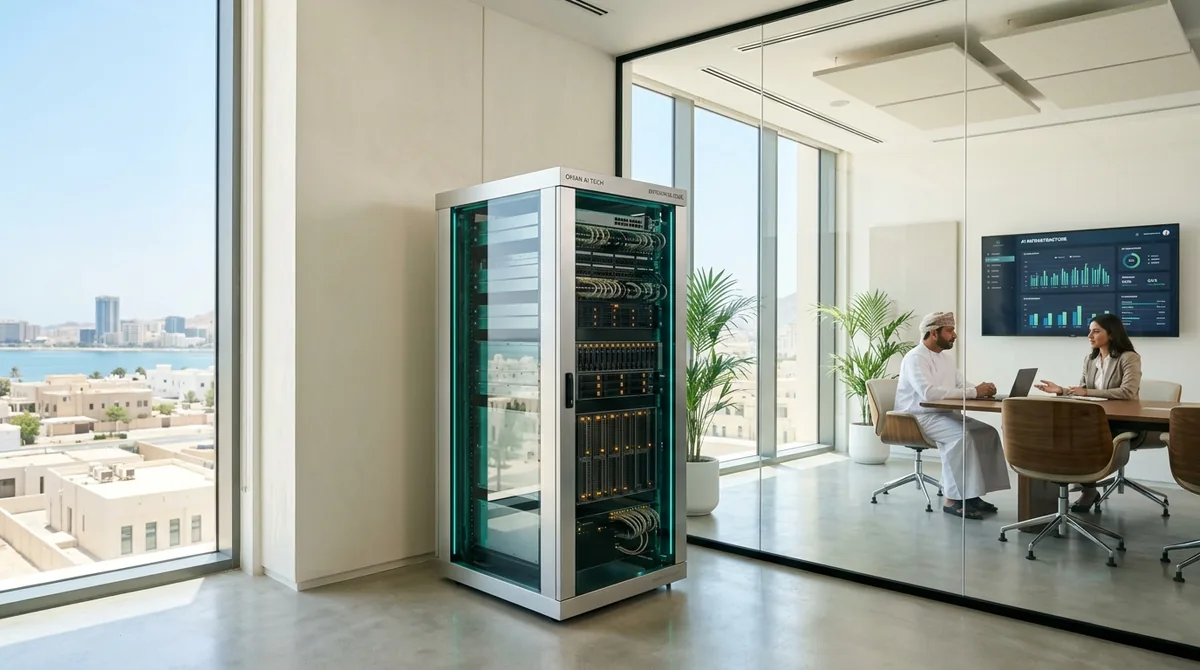
Enterprise technology leaders across Muscat, Sohar, and Salalah face a pivotal architectural dilemma when rolling out artificial intelligence: should proprietary corporate workflows run on self-hosted internal servers or leverage scalable cloud AI endpoints? As automated document pipelines, customer service agents, and internal decision engines become central to daily business operations, the underlying infrastructure determines not only operational reliability but also regulatory compliance and long-term financial exposure.
In the Sultanate of Oman, this decision is not merely an engineering preference. Stricter data residency governance enforced under the Omani Personal Data Protection Law (PDPL - Royal Decree 6/2022) and sector-specific oversight from the Central Bank of Oman (CBO) have forced executive teams to audit every packet of customer and proprietary data leaving their corporate perimeter.
What Is the Difference Between Self-Hosted and Cloud AI Infrastructure?
Self-hosted AI executes neural models directly on physical on-premises servers or local private colocation racks, while cloud AI transmits prompts to third-party data centers over the public internet. For Omani enterprises, self-hosting ensures 100% in-country data residency without external network dependencies.
In a cloud AI deployment, your internal applications communicate via REST APIs with overseas or regional multi-tenant servers managed by hyperscalers such as OpenAI, Microsoft Azure, Google Cloud, or AWS. Every time an employee summarizes a client dossier or a customer interacts with an automated assistant, plain text or vectorized payloads travel across wide-area networks. While cloud providers offer rapid provisioning, elastic scalability, and zero hardware maintenance, the data owner relinquishes physical control over the compute environment.
Conversely, self-hosted AI architecture deploys optimized open-weights models—such as Llama 3.3, Mistral Large, or DeepSeek R1—on dedicated local hardware using high-throughput serving engines like vLLM or Ollama. The server sits physically inside your Muscat headquarters or within a certified local tier-3 colocation facility. No prompt, embedding, or database record ever exits the internal local area network (LAN), creating an impenetrable air-gapped security boundary.
How Does Omani PDPL Impact Cloud vs. On-Premises AI Deployments?
The Omani Personal Data Protection Law (Royal Decree 6/2022) prohibits transferring personal identification data outside the Sultanate without explicit ministerial authorization. Self-hosted infrastructure eliminates cross-border transfer risks, whereas public cloud models require exhaustive data mapping and legal approvals.
Compliance guidelines published by the Ministry of Transport, Communications and Information Technology (MTCIT) specify that corporate data controllers must protect user privacy and restrict unauthorized foreign exposure. Under Article 23 and associated executive regulations, transferring customer records, civil numbers, financial logs, or medical histories to offshore cloud clusters without documented user consent can result in administrative fines reaching up to OMR 500,000 and mandatory suspension of digital operations.
When deploying cloud AI, organizations must confirm whether the cloud vendor trains future models on incoming prompts, whether intermediate chat logs are cached in foreign jurisdictions, and whether sub-processors meet Omani sovereign standards. For complete architectural guidance on legal frameworks, review our detailed analysis on Oman PDPL compliance for automated AI workflows and explore how to connect AI models to private databases securely.
Infrastructure Comparison Matrix for Omani Enterprises
| Evaluation Metric | Self-Hosted (On-Premises) | Omani Sovereign Cloud (Omantel/OTech) | Global Public Cloud (US/EU) |
|---|---|---|---|
| PDPL Data Sovereignty | 100% In-House Isolation | 100% In-Country Residency | Requires MTCIT Cross-Border Permit |
| Upfront Capital Expenditure | OMR 8,500 – OMR 24,000 | OMR 400 – OMR 1,200 (Setup) | OMR 0 (Pay-as-you-go) |
| Monthly Recurring Cost | OMR 45 – OMR 90 (Power & Cooling) | OMR 380 – OMR 1,400 / month | OMR 250 – OMR 2,200 (Token Volatility) |
| Internal Inference Latency | 22ms – 38ms (LAN speed) | 45ms – 75ms (National WAN) | 140ms – 320ms (International hops) |
| Internet Outage Resilience | Fully Operational Offline | Requires National Connectivity | Total Outage on Fiber Cut |
| Best Architectural Fit | Banks, Defense, Law Firms, Clinics | Mid-Tier Enterprises, Retail Chains | Public Marketing, Generic Inquiries |
What Are the Real Cost and Hardware Trade-Offs for Omani Enterprises in 2026?
Self-hosting requires an initial capital expenditure of OMR 8,500 to OMR 24,000 for high-density GPU nodes, delivering predictable fixed operating overhead. Cloud AI eliminates hardware investment but introduces variable token expenses ranging from OMR 350 to OMR 2,200 monthly as workflow usage expands.
A mid-sized logistics or trading company in Oman processing 45,000 customer WhatsApp conversations and 3,500 internal ERP document queries monthly consumes approximately 80 million tokens. On proprietary cloud models like GPT-4o or Claude 3.5 Sonnet, this volume generates a variable monthly invoice of OMR 580 to OMR 890, amounting to over OMR 10,000 annually in unrecoverable operational expenses.
In comparison, investing in an on-premises 4U server equipped with dual NVIDIA RTX 6000 Ada GPUs (96GB total VRAM) or an enterprise Apple Silicon cluster running quantized open-weights models amortizes within 14 to 18 months. Once purchased, generating 100 million tokens incurs zero additional marginal software licensing costs, shielded entirely from foreign exchange fluctuations and API price increases.
Which Infrastructure Delivers Superior Performance, Latency, and Uptime in Muscat?
On-premises edge AI clusters deliver sub-35ms response times across local enterprise networks, outperforming international cloud APIs that average 180ms due to international routing latency. Self-hosted servers also continue running during undersea submarine cable cuts.
Real-time conversational agents and high-throughput automated workflows depend heavily on low Time to First Token (TTFT). For a customer service department handling peak seasonal traffic in Muscat, routing requests through overseas servers introduces perceptible 1.2 to 2.5-second pauses between conversational turns. Self-hosted nodes integrated with internal databases process requests at local network wire speeds, delivering instantaneous feedback.
Furthermore, local hosting safeguards business continuity against international telecom disruptions. When undersea fiber cables in the Arabian Sea suffer maintenance cuts, cloud-dependent operations grind to a halt. Self-hosted AI architectures continue processing invoices, categorizing tickets, and serving internal staff without interruption, directly advancing the resilience goals outlined in Oman Vision 2040. To understand broader regional hosting frameworks, explore our comparative guide on GCC data sovereignty and on-premise AI workflows.