

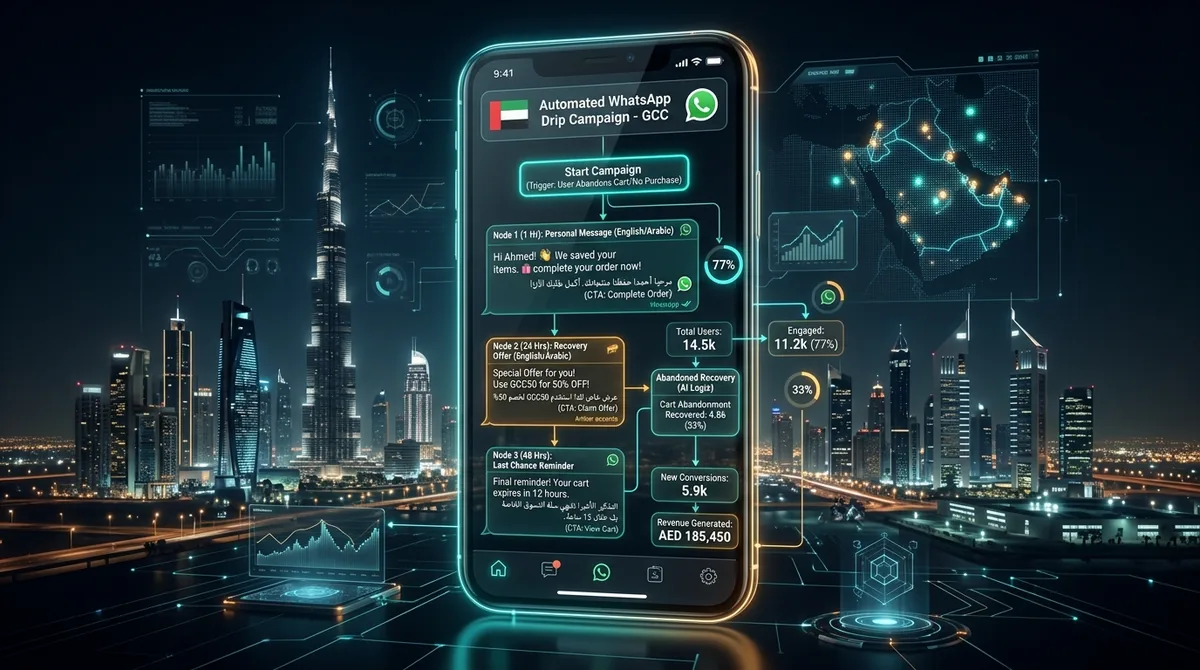
E-commerce brands operating across Saudi Arabia, the United Arab Emirates, Kuwait, Qatar, Bahrain, and Oman face two persistent operational leaks: staggering cart abandonment rates exceeding 70% and Cash-on-Delivery (COD) failure rates that frequently hover between 35% and 45%. As customer acquisition costs (CAC) climb on Meta and TikTok ads, relying on Western email marketing playbooks yields diminishing returns.
Consumer behavior in the GCC is fundamentally mobile-first. Shoppers communicate with family, local businesses, and government services primarily through WhatsApp. Automating smart, event-driven messaging sequences directly on WhatsApp bridges the gap between intent and finalized payment, turning abandoned checkouts into predictable revenue.
Why Do Traditional Email Flows Fail for GCC E-Commerce?
Traditional email automation fails in the Gulf because local consumers treat email as a formal administrative tool rather than a daily conversational channel. While North American retail email flows average 21% open rates, regional GCC e-commerce email open rates languish at 11.4%, with click-through rates under 1.8%.
In contrast, the WhatsApp Business Platform registers open rates of 98%, with over 80% of messages read within the first 5 minutes of delivery. In markets like Saudi Arabia and the UAE, smartphone penetration surpasses 96%, and WhatsApp represents the default digital operating system. When a shopper in Muscat or Jeddah abandons a cart containing 45 OMR or 450 SAR worth of items, an email notification lands unseen in a promotional tab. A personalized WhatsApp message with dynamic item previews and an instant checkout link reaches the customer during their active buying cycle.
Furthermore, traditional email cannot resolve address ambiguity—the single largest contributor to failed deliveries and return-to-origin (RTO) courier costs in the Arabian Peninsula. Automated conversational flows enable buyers to drop a live WhatsApp location pin, confirming accurate delivery routing in seconds.
What Are the 5 Core WhatsApp Drip Sequences Every GCC Store Needs?
To maximize revenue and protect logistics margins, GCC e-commerce operators must deploy five distinct automated sequences: Cart Abandonment Recovery, COD Order Confirmation and Address Verification, Post-Purchase Replenishment, Win-Back Re-engagement, and Automated Review Collection.
Rather than sending generic blast broadcasts that risk phone number flagging, high-performing brands configure deterministic, event-based triggers. Below is the operational blueprint and performance benchmark for each sequence:
| Drip Sequence | Trigger Event & Timing | Message Architecture | Target Conversion | Key GCC Benchmark |
|---|---|---|---|---|
| 1. Abandoned Cart Recovery | Triggered 35 mins post-abandonment; Step 2 at 24 hrs | Dynamic product thumbnail, item title, pre-filled checkout link, optional 10% instant voucher | 28% – 34% recovery | Recovers 3,200 OMR ($8,300 USD) per 10k store visits |
| 2. COD Verification & Location Pin | Instant trigger upon COD order placement | Interactive Quick-Reply buttons ("Confirm Order" / "Cancel") + Request Location Pin link | 91% verification rate | Slashes RTO returns from 42% down to 11.5% |
| 3. Post-Purchase Replenishment | Product lifespan minus 7 days (e.g., Day 23 for 30-day supply) | Personalized consumption check-in + 1-click reorder CTA via Thawani / BenefitPay / Apple Pay | 19% repeat purchase | Increases 90-day customer LTV by 44% |
| 4. VIP Win-Back & Loyalty Nurture | 45 days of customer dormancy post-first order | Curated recommendations based on past category affinity + exclusive tier discount | 14% reactivation | Cuts retargeting ad spend by 26% |
| 5. Automated Review & UGC Collection | 3 days after courier webhook confirms delivery | Interactive 5-star rating selector + prompt to upload product photo directly in chat | 38% response rate | Generates 4.5x more authentic local Arabic reviews |
"Shifting our cart recovery and COD validation from SMS and email to structured WhatsApp drip workflows lowered our lost package rate from 38% to 9% in Riyadh while lifting gross recovered sales by 310,000 SAR within four months."
How Do You Integrate WhatsApp Drips with Salla, Zid, and Shopify?
Connecting automated drip campaigns requires bridging your e-commerce store engine (Salla, Zid, Shopify MENA, or WooCommerce) with the official Meta WhatsApp Business Cloud API through an orchestration layer such as self-hosted n8n or Make.
The integration follows four technical stages:
- Webhook Subscription: Configure store webhooks for events including
cart/abandoned,order/created, andfulfillment/updated. - Customer Language & Locale Parsing: The automation engine checks the buyer's phone country code (+968 for Oman, +966 for Saudi Arabia, +971 for UAE) and checkout language preference, routing the payload to either a Gulf Arabic or English approved template.
- Currency & Deep-Link Formatting: The payload formats numbers into local currency symbols (OMR, SAR, AED) and attaches secure, tokenized checkout recovery links containing UTM parameters for accurate attribution.
- State Management & Cooldown Filters: To prevent messaging fatigue, logic gates verify that the customer has not received a promotional notification within the preceding 72 hours.
For merchants operating in Oman and Bahrain, integrating native regional payment gateways like Thawani, OmanNet, and BenefitPay into the message checkout link produces conversion rates 2.4x higher than standard card input forms, as explored in our guide on integrating WhatsApp API with local Gulf payment gateways.
How Do You Ensure 100% Compliance with Omani and Saudi Data Privacy Regulations?
Compliance is maintained by capturing explicit opt-in consent during checkout, providing mandatory opt-out keywords in every message, and storing conversation metadata on secure infrastructure aligned with the Omani Personal Data Protection Law (Royal Decree 6/2022) and the Saudi National Data Management Office (NDMO) standards.
To avoid Meta quality score downgrades and legal exposure, e-commerce managers must adhere to three non-negotiable rules:
- Transparent Checkbox Consent: Include an un-checked consent box at checkout: "Receive order updates and exclusive offers via WhatsApp". Silent opt-ins violate regional privacy laws.
- Frictionless Opt-Out: Every marketing drip must include an automated opt-out footer, such as: "Reply STOP to unsubscribe | للرد بإلغاء الاشتراك أرسل قف". Inbound cancellation keywords must instantly flag the CRM record.
- Template Pre-Approval: All outbound drip messages must use pre-approved Meta Utility or Marketing templates. Never run unverified mass broadcasts from personal SIM cards, which lead to permanent number bans within 48 hours. Review our detailed breakdown on PDPL compliance checklists for e-commerce to safeguard your customer data pipeline.