

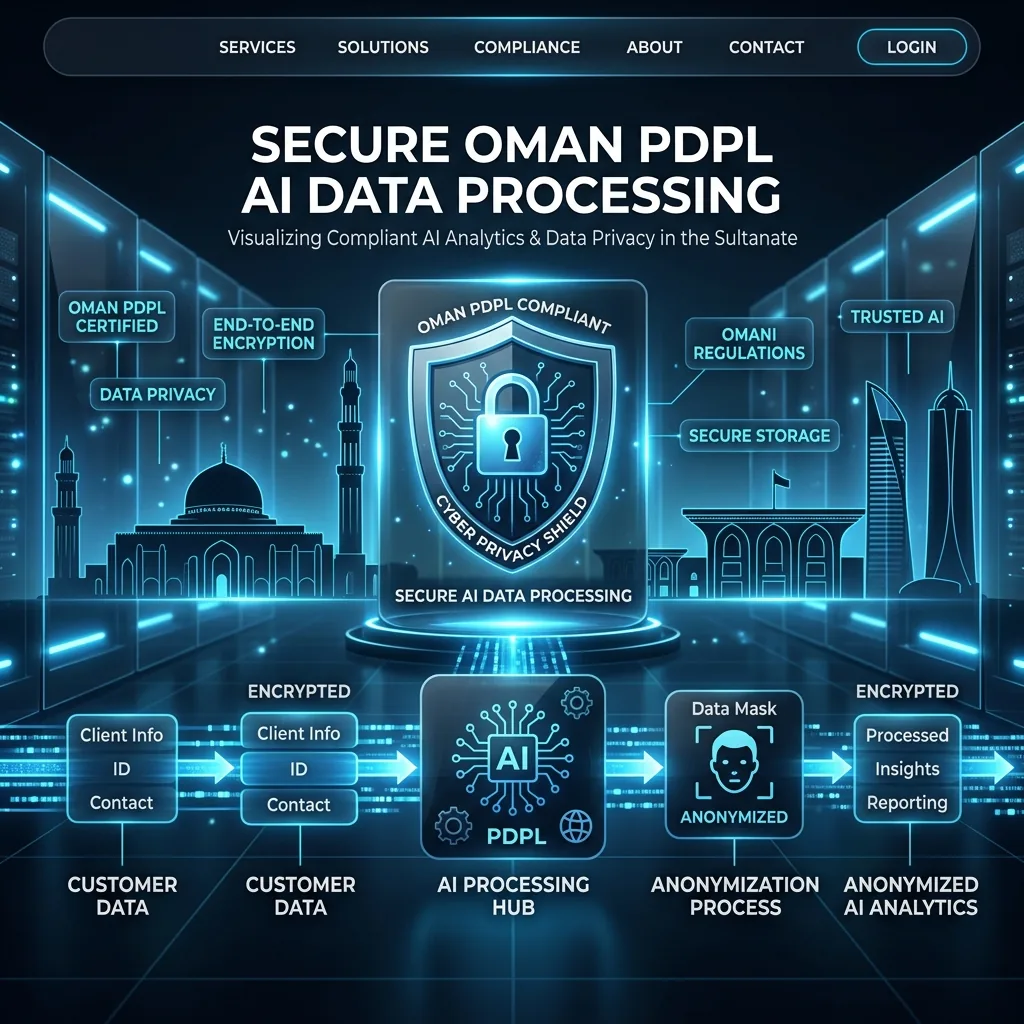
Omani commercial enterprises across Muscat, Sohar, and Salalah are rapidly deploying artificial intelligence to automate customer service, score leads, and extract operational insights. However, feeding raw customer records—such as civil ID numbers, phone contact logs, transaction histories, and delivery addresses—into public AI platforms poses massive regulatory risks. Under the Omani Personal Data Protection Law (PDPL), enacted via Royal Decree 6/2022, unauthorized processing or cross-border transmission of personal data carries severe legal liabilities, including administrative penalties of up to OMR 500,000.
Commercial teams must balance the transformative operational benefits of automated intelligence with strict compliance frameworks mandated by the Ministry of Transport, Communications and Information Technology (MTCIT). Failing to implement robust data masking, consent controls, and localized infrastructure can expose an executive board to operational shutdown orders and permanent reputational damage. To safely harness AI without incurring statutory penalties, organizations require a clear architectural strategy for personal data management.
What is Oman Personal Data Protection Law (PDPL)?
Oman PDPL, enacted under Royal Decree 6/2022, is the definitive statutory regime regulating how commercial entities collect, store, transmit, and process personal data of individuals residing in the Sultanate of Oman. It grants data subjects explicit privacy rights and mandates legal grounds for data handling.
The law establishes clear definitions for personal data, categorizing any information that directly or indirectly identifies a natural person—such as names, biometric profiles, financial records, geographic coordinates, and online identifiers—as protected information. Controllers operating in Oman are legally obligated to respect core data protection principles: lawfulness, purpose limitation, data minimization, accuracy, storage limitation, and strict confidentiality. When applying artificial intelligence to commercial operations, every algorithmic model or data processing pipeline must adhere to these foundational principles.
Does AI processing of customer data fall under Oman PDPL jurisdiction?
AI processing of customer data falls entirely under Oman PDPL jurisdiction whenever an algorithm, machine learning model, automated script, or LLM ingests, transforms, or stores personally identifiable information originating from individuals residing in Oman.
Whether your commercial team utilizes a cloud-based conversational assistant, an automated document parsing model, or an AI sales scoring pipeline, sending customer payloads into model prompts constitutes formal "processing" under Royal Decree 6/2022. If an employee inputs unencrypted customer chat transcripts containing phone numbers into a foreign AI model, your organization has executed an unapproved cross-border data transfer. Consequently, compliance audits evaluate AI prompt pipelines with the exact same rigor as traditional SQL database architecture.
Key statutory obligations under Royal Decree 6/2022 for commercial AI workloads include:
- Explicit Opt-in Consent: Securing verifiable permission from customers prior to submitting their data into automated processing routines.
- Data Minimization: Extracting only the exact data fields strictly necessary for the designated AI inference task.
- Cross-Border Transfer Restrictions: Prohibiting the transmission of personal data outside Omani territory without prior authorization from the MTCIT.
- Data Subject Access Rights: Granting customers the statutory right to request deletion or inspection of their personal records stored within AI training datasets or memory stores.
What are the penalties for violating PDPL laws when using AI in Oman?
Violating PDPL laws when using AI in Oman results in administrative penalties reaching up to OMR 500,000, mandatory suspension of commercial processing operations, regulatory public disclosures, and potential criminal imprisonment for severe data breaches.
The MTCIT possesses broad enforcement power to audit corporate IT infrastructure, mandate immediate deletion of non-compliant AI model weights or vector embeddings, and issue cease-and-desist orders to non-compliant digital platforms. For mid-market Omani enterprises, a single data spill caused by an unvetted third-party AI integration can erase years of brand equity while inflicting paralyzing financial liability. A single breach event has been shown to increase customer churn by up to 45% within 90 days following a public breach notification.
How can Omani businesses process customer data using AI safely?
To process customer data using AI safely, Omani businesses must deploy a robust 5-step data governance framework that combines local data masking, self-hosted LLM middleware, explicit consent management, granular access logging, and localized cloud infrastructure.
1. Implement a Local Data Anonymization Pipeline
Before any customer payload reaches an AI engine, it must pass through an automated on-premise data masking middleware. This pre-processing layer scans incoming text, documents, and form submissions for personal identifiers using named entity recognition (NER) models. Names are replaced with randomized tokens (e.g., [CUSTOMER_ID_104]), phone numbers are converted to generic tags, and civil IDs are stripped entirely. Because anonymized data no longer identifies a natural person, processing anonymized tokens dramatically reduces PDPL liability.
2. Leverage Local Omani Sovereign Cloud Infrastructure
To guarantee complete data residency, enterprise organizations can host open-source AI models (such as Llama 3, Mistral, or specialized Arabic LLMs like Ma'een) on domestic sovereign cloud providers like Omantel or regional Omani data centers in Muscat. By running model weights entirely within national borders, 100% of customer telemetry stays enclosed within Omani network space, eliminating cross-border data transfer violations under Royal Decree 6/2022.
3. Establish Explicit WhatsApp & Web Consent Controls
When interacting with Omani consumers via automated channels such as WhatsApp Business API or website AI chat widgets, businesses must incorporate transparent privacy disclosures. Before the conversational agent records customer requests, the user must receive a clear opt-in prompt stating: "We process your query using automated AI systems in compliance with Oman PDPL. Click Agree to continue." Maintaining audit logs of user consent timestamps protects the company during MTCIT regulatory reviews.
4. Enforce Zero Data Retention Policies with Commercial Vendors
If your commercial workflow requires connecting to global enterprise AI APIs, select enterprise-grade endpoints that offer formal zero data retention (ZDR) agreements. Ensure contracts explicitly state that submitted customer API payloads will never be logged, cached on foreign servers, or utilized by vendor engineers for model retraining. Combining ZDR contractual guarantees with upstream client-side anonymization creates a resilient defense-in-depth architecture.
5. Perform Bi-Annual AI Privacy Impact Assessments
AI models and commercial workflows evolve over time. Establishing a structured 90-day internal audit cycle ensures that new API connections, database integrations, and customer service prompts are reviewed against updated MTCIT guidance. Documenting your data flow diagrams and risk mitigation strategies demonstrates proactive governance and compliance maturity in alignment with Oman Vision 2040 digital economy goals.
"Compliance is not an obstacle to AI adoption—it is the prerequisite for sustainable enterprise automation. Companies that protect customer privacy build enduring market trust while shielding their balance sheet."