

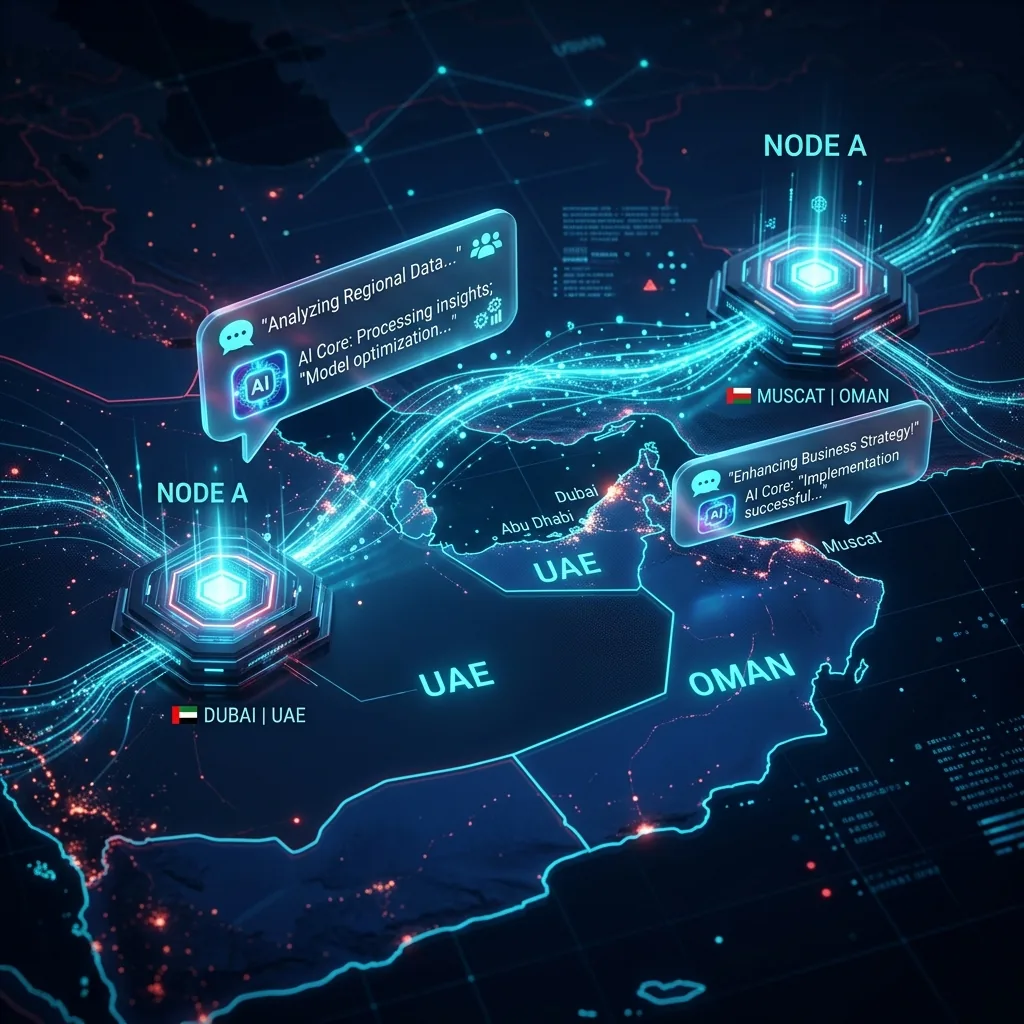
If you manage customer service operations across the GCC, you know that resolving 24/7 inquiries without burning out your staff is a monumental challenge. Whether you are running a real estate firm in Dubai or a luxury hospitality brand in Muscat, the pressure to deliver instant, accurate responses over WhatsApp is immense. However, deploying an AI receptionist is not a one-size-fits-all endeavor. What works flawlessly in the UAE might fail compliance or alienate customers in Oman.
As AI adoption surges in 2026, many businesses attempt to use generic chatbot templates across their entire Middle Eastern portfolio, only to face strict legal penalties or plummeting conversion rates. Understanding the distinct differences in regulatory frameworks, linguistic preferences, and integration ecosystems between the UAE and Oman is essential for a successful rollout.
Why is Regulatory Compliance Different Between the UAE and Oman?
Compliance differs because the UAE enforces the Federal Personal Data Protection Law, while Oman relies on Royal Decree No. 6/2022 (PDPL). To deploy a WhatsApp AI safely, you need data localization strategies tailored to each country's specific legal framework.
In the UAE, the data protection landscape is heavily segmented. If you operate in a free zone like the DIFC or ADGM, you are subject to distinct data privacy regulations that are modeled closely on the GDPR. The UAE federal law generally requires stringent consent mechanisms and mandates that highly sensitive data be hosted within local cloud infrastructure. For an AI receptionist, this means your generative AI models and conversation logs must be securely processed through GCC-based servers, such as the AWS regions in the UAE.
Conversely, Oman's Personal Data Protection Law (PDPL), issued under Royal Decree No. 6/2022, places an intense focus on consumer consent and the prohibition of processing specific types of sensitive data without explicit approval from the Ministry of Transport, Communications and Information Technology (MTCIT). If your Omani WhatsApp AI collects civil IDs or exact locations for deliveries, non-compliance can result in fines reaching up to 500,000 OMR. A unified GCC rollout requires a custom architecture that dynamically routes UAE customer data to local servers and applies Omani consent flows for users in Muscat.
How Does Customer Behavior Change Between Dubai and Muscat?
Customer behavior changes because Dubai demands hyper-fast, multilingual interactions, whereas Muscat prioritizes localized Omani dialect and relationship-building. To succeed in both markets, you need an AI receptionist trained on these distinct cultural nuances.
In Dubai's hyper-competitive market, speed is the primary currency. A consumer inquiring about a service on WhatsApp expects an accurate response within seconds. Moreover, the UAE's expatriate majority means your AI receptionist must seamlessly switch between English, formal Arabic, Hindi, and Tagalog. If the AI hallucinates or fails to parse a multilingual query, the prospect will instantly message a competitor. The objective in the UAE is frictionless transaction speed.
In contrast, the Omani market deeply values rapport and conversational warmth. A business operating in both Salalah and Abu Dhabi will typically notice a 40% difference in average conversation length. Omani clients prefer to exchange formal greetings and build a sense of trust before finalizing a booking. If your AI sounds too robotic or uses standard Egyptian Arabic templates, it will feel jarring. An effective Omani AI must be fine-tuned on local Khaleeji dialects and programmed to engage in polite conversational padding before executing a task.
What is the Cost Difference for WhatsApp AI in the GCC?
The cost difference depends heavily on API integration and local hosting requirements. A UAE-based AI receptionist might cost around $1,500 monthly for high-volume multilingual support, whereas an Omani setup typically averages 400 OMR ($1,040) focusing on localized Arabic interactions.
When calculating the return on investment, business leaders must account for structural pricing differences. Meta's WhatsApp Business API charges per conversation, and these rates are relatively standard across the GCC. However, the backend processing power dictates the monthly overhead. In the UAE, where businesses often handle thousands of daily inquiries across four different languages, the token usage for advanced LLMs (Large Language Models) is significantly higher.
In Oman, businesses generally experience a slightly lower volume of highly targeted queries. An investment of 400 OMR ($1,040) per month in an Omani AI setup can easily save a local company up to 25 hours a week in manual customer service labor. This translates to a massive ROI when human receptionists are freed up to handle complex, high-ticket sales rather than answering repetitive questions about working hours or location pins.
Which Platform Should You Choose for Regional Expansion?
Choosing a platform depends on your expansion goals and current CRM infrastructure. To scale across the GCC effectively, you need a custom-built WhatsApp AI that integrates seamlessly with both local payment gateways (like OmanNet) and international ones (like Stripe in the UAE).
Many business owners attempt to use off-the-shelf SaaS tools like ManyChat or Tidio for their regional operations. While these are fine for basic auto-replies, they fall apart when you need to integrate deeply with regional systems. For instance, an AI receptionist in Dubai might need to seamlessly hand off payments to Stripe or integrate with HubSpot for global CRM tracking.
Meanwhile, the same company's Oman branch might require the AI to generate payment links specifically through OmanNet or Thawani to cater to local preferences. A custom-built AI automation solution bypasses these limitations by utilizing specific API bridges, ensuring that your business operates legally and efficiently, regardless of which side of the border your customer is messaging from.