

Every day, your customer service team is drowning in repetitive inquiries. "What are your prices?" "Where is your store located?" "Do you offer delivery to Salalah?" Responding to these basic questions manually burns countless hours, frustrates customers expecting instant replies, and ultimately costs you sales. You know you need an automated chat solution, but the market is flooded with options. Between website widgets, social media bots, and deeply integrated messaging systems, selecting the wrong platform means wasting money and frustrating your audience. If you operate in the Middle East, standard global solutions often fall short of local expectations.
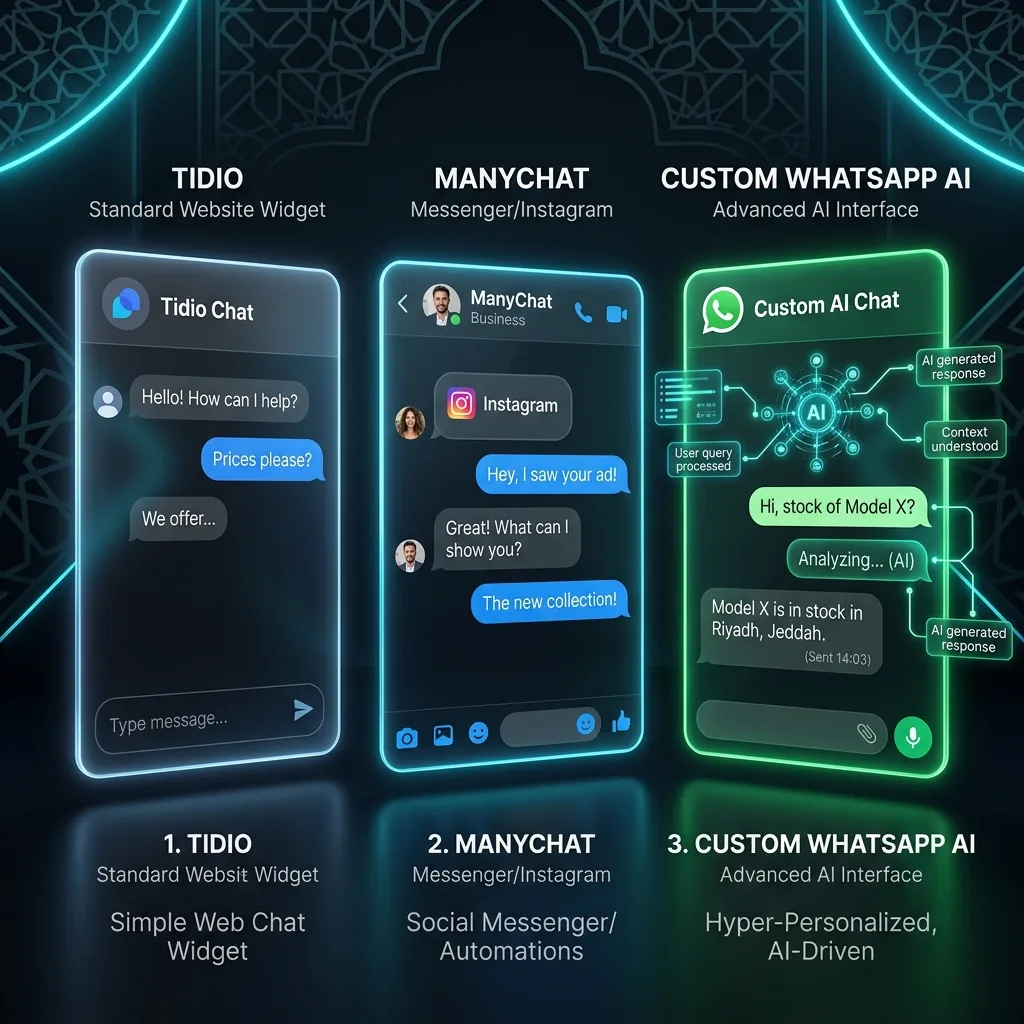
When businesses in the region decide to automate their communications, the conversation usually boils down to three distinct paths: deploying a standard website widget like Tidio, using social media automation tools like ManyChat, or investing in a Custom WhatsApp AI solution. Making the right choice requires a deep understanding of your customer acquisition channels and how consumers actually behave in the Gulf market.
What Is Tidio and When Should You Use It?
Tidio is a live chat and basic chatbot widget designed primarily for websites. To use it effectively, your business must rely heavily on direct website traffic rather than social media or messaging apps for customer acquisition.
For years, Tidio has been a popular entry-level tool for e-commerce platforms. It places a neat, familiar bubble in the bottom corner of your webpage. When a visitor lands on your site, Tidio can proactively trigger a greeting, offer a discount code, and allow the user to connect with a human agent. It also features a visual builder that lets you create simple decision trees. For example, if a user clicks "Track Order," the bot can ask for an order number.
However, the fundamental limitation of Tidio—especially in the context of the GCC—is its reliance on the browser session. If a user in Muscat visits your website on their phone, asks a question via the Tidio widget, and then switches apps to answer an Omantel text message, the session is often lost. When they close their browser, your ability to reach back out to them vanishes unless they explicitly provided an email address. In a market where email marketing has drastically lower open rates compared to instant messaging, relying on a website widget can lead to a massive drop-off in lead retention.
Pricing: Tidio offers a free tier with severe limitations, but practical business usage requires their premium plans starting at around $29 USD per month, scaling up significantly as your traffic and agent count increase.
How Does ManyChat Compare for Social Media Automation?
ManyChat is an automation tool built specifically for Instagram, Facebook Messenger, and SMS. It is best used if your primary lead generation strategy revolves around social media engagement, direct messages, and automated comment replies.
If your marketing strategy is heavily focused on Instagram reels, influencer partnerships, and sponsored Facebook posts, ManyChat is an incredibly powerful tool. It allows you to set up rules where if a user comments a specific keyword (e.g., "PRICE") on your Instagram post, ManyChat will instantly send them a Direct Message with the product details and a link to buy. This frictionless transition from public comment to private inbox is highly effective for lifestyle brands, fashion retailers, and restaurants.
Yet, ManyChat has significant constraints. It operates on rigid, rule-based flows. If a customer deviates from your predefined paths—asking a nuanced question about product compatibility—the bot typically fails and passes the conversation to a human. Furthermore, ManyChat is tightly bound by Meta's strict 24-hour rule for Messenger and Instagram. If a user hasn't interacted with your bot in the last 24 hours, you cannot send them promotional messages. This makes long-term nurturing difficult without relying on paid broadcast features.
Pricing: ManyChat’s Pro plan is highly accessible, starting at roughly $15 USD per month for up to 500 contacts. However, as your database grows, this monthly recurring cost scales proportionately, often reaching hundreds of dollars for large social followings.
Why Is Custom WhatsApp AI Dominating the GCC Market?
Custom WhatsApp AI is a tailored intelligent assistant built on the WhatsApp Business API. It dominates the region because GCC consumers overwhelmingly prefer WhatsApp over website chats, allowing businesses to offer personalized, 24/7 service directly on their phones.
In Oman, Saudi Arabia, and the UAE, WhatsApp is not just a messaging app; it is the internet. Consumers expect to conduct business, send documents, share locations, and finalize purchases entirely within WhatsApp. A Custom WhatsApp AI leverages this cultural behavior. Unlike ManyChat’s rigid flows, a custom AI uses Large Language Models (like OpenAI’s GPT-4 or Anthropic’s Claude) to understand natural language. It doesn't rely on users clicking the right buttons; it can comprehend complex queries, understand Khaleeji dialects, and hold a dynamic conversation.
Furthermore, because it is custom-built, it connects directly to your business backend. If a customer asks, "Do you have the blue variant in stock at your Sohar branch?", the Custom WhatsApp AI can query your actual inventory database in real-time and reply instantly. It operates persistently; the chat history remains on the customer's phone forever, making re-engagement and follow-ups incredibly natural. As businesses align with strategic regional goals like Oman's Vision 2040, digitizing and personalizing the customer experience through native channels is paramount.
Which Chatbot Solution Is the Most Cost-Effective?
Tidio and ManyChat offer low monthly subscriptions starting around $15 to $29 USD, while a Custom WhatsApp AI requires a higher initial investment (typically 500 to 2000 OMR) but delivers superior ROI through deep integration and higher conversion rates.
When evaluating costs, business owners must look beyond the sticker price. A $15/month ManyChat subscription sounds cheap, but if it fails to answer 40% of customer questions, requiring you to hire two full-time customer service agents at 400 OMR a month each, the true cost of your customer service operations remains high.
Conversely, a Custom WhatsApp AI involves a significant upfront development cost. A professional agency will typically charge between 500 OMR and 2,000 OMR to map your business logic, integrate APIs, train the AI on your specific data, and ensure compliance with local regulations like the Omani Personal Data Protection Law (PDPL). After the initial build, ongoing costs are generally limited to cloud hosting (around $20-$50 USD/month) and Meta’s WhatsApp API per-conversation fees (approximately $0.03 USD per user-initiated session). Because the AI can autonomously resolve 80-90% of inquiries, it effectively replaces the need for an expanding human support team, yielding a massive return on investment within the first quarter of deployment.
Ultimately, the choice depends on your business maturity. If you are a brand new startup testing the waters, ManyChat or Tidio are excellent, low-risk starting points. But if you have an established business, high message volume, and a need to seriously scale your operations without linearly scaling your payroll, a Custom WhatsApp AI is the definitive solution.