

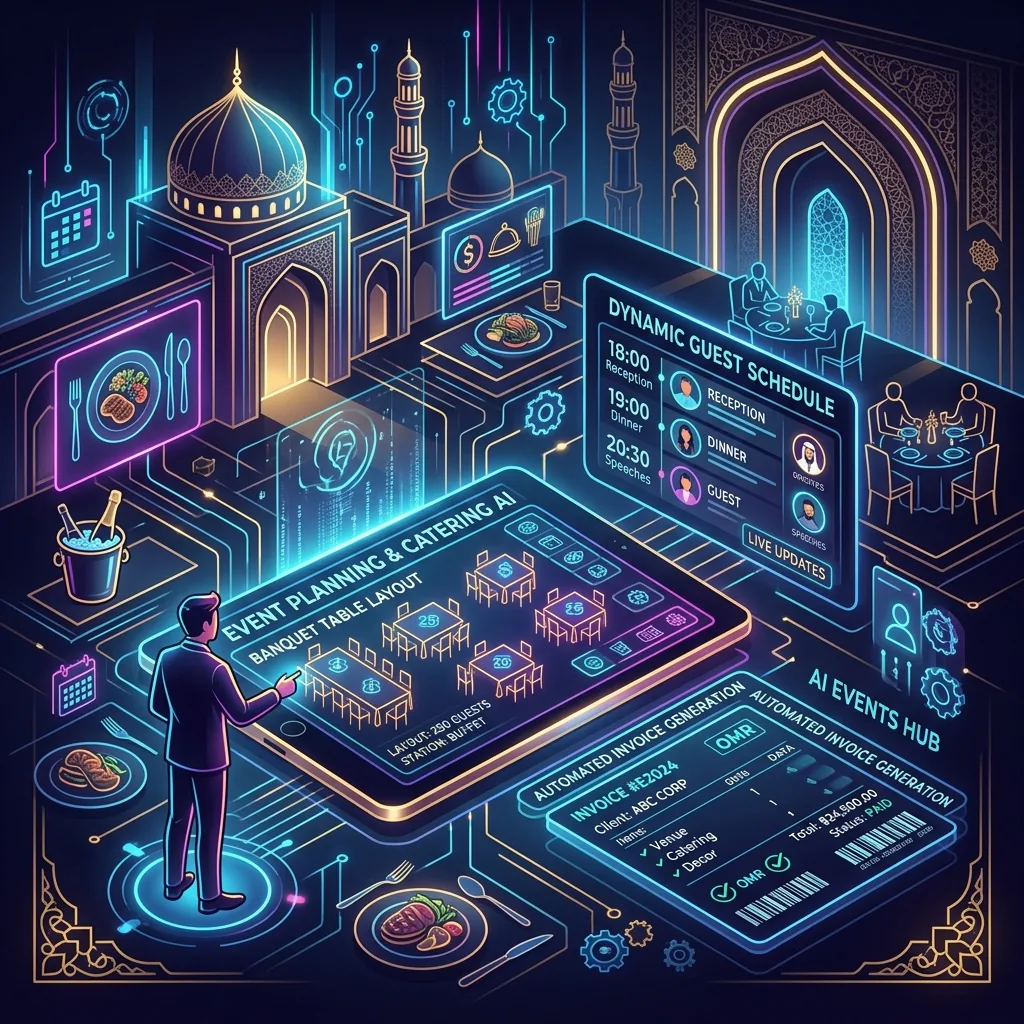
Catering and event management companies in Muscat operate in a fast-paced market where coordination speed dictates success. From corporate banquets in Madinat Al Sultan Qaboos to wedding receptions in Al Seeb, operators face constant inquiries regarding venue availability, menu customizations, and pricing. Delayed responses cause prospective clients to turn to competitors. To secure these bookings, event managers are adopting automated workflows that connect customer inquiries directly to final invoices.
To automate event pipelines, operators integrate unified systems. Large Language Models (LLMs) process text and structured data to interpret menu customization requests and estimate costs dynamically. Businesses also deploy Conversational AI, such as intelligent chatbots, on platforms like WhatsApp Business API to qualify leads, present menu alternatives, and schedule venue tours automatically.
How does AI automate catering and event inquiries in Muscat?
Direct Answer: AI automates catering and event inquiries by instantly responding to incoming customer requests via WhatsApp and web chat. It checks calendar availability, provides custom menu packages, and collects guest numbers to qualify leads without human delays.
Event planning requires multiple negotiation stages. When a Muscat client submits an inquiry, they expect immediate feedback on dietary restrictions, menus, and costs. Traditionally, managers consult chefs, calculate costs, and check availability—a cycle taking up to 48 hours. By utilizing Retrieval-Augmented Generation (RAG) to reference verified documents, a chatbot can instantly answer questions about menus and booking availability using live schedules.
Because the AI assistant connects to the catering company's CRM, it collects essential details like guest counts, event dates, and venue locations. It then suggests custom menu packages based on this data. For a banquet of 250 guests, the AI presents structured package options and offers to schedule a tasting session, transferring qualified leads to the sales team for final closure. To review how automated communications keep customers engaged, read our detailed look at WhatsApp AI receptionists in Oman to optimize front-desk operations.
What is the financial return of automating the event invoicing pipeline?
Direct Answer: To automate the event invoicing pipeline, you need to integrate conversational AI with your CRM and financial systems. This reduces invoice generation delays by 90% and saves catering businesses up to OMR 1,500 in monthly administrative overhead.
Managing financial workflows manually in the events industry is slow and prone to errors. Discrepancies between quotes, menu adjustments, and final invoices delay payments. In contrast, an automated system updates invoice amounts dynamically. If a client increases their guest list from 150 to 185 guests three days before a banquet, the AI updates the event ledger, calculates the new total in Omani Rials (OMR), and generates a revised invoice within seconds. The table below illustrates the efficiency gains realized by transitioning to automated billing pipelines:
| Operational Variable | Traditional Manual Booking & Invoicing | AI-Automated Inquiry-to-Invoice System |
|---|---|---|
| Inquiry Response Time | 4 to 12 Hours (Often longer on weekends) | Under 30 Seconds (Instant response 24/7) |
| Menu Customization Costing | Manual spreadsheet calculation (1-2 Hours) | Instant automated recalculation (3 Seconds) |
| Invoice Generation Latency | 1 to 3 Days after menu confirmation | Instant generation and delivery (Under 1 Minute) |
| Admin Staff Hours Saved | 20+ Hours per week spent on scheduling & billing | Less than 2 Hours per week (Review only) |
| Monthly Savings (OMR) | Zero (High administrative overhead) | Saves up to OMR 1,500/month in labor & bookings |
By automating these administrative steps, Muscat catering firms can reallocate resources to food quality, supporting the goals of Oman Vision 2040. Additionally, faster invoicing ensures a healthier cash flow, allowing companies to invest in premium ingredients. For business owners looking to identify other operational bottlenecks, reviewing our 2026 operational audit checklist offers a practical starting point.
How does catering automation comply with Oman's Personal Data Protection Law?
Direct Answer: Catering automation complies with Oman's Personal Data Protection Law (PDPL) by utilizing localized cloud storage, end-to-end data encryption, and role-based access permissions. This prevents unauthorized access to customer contacts, banquet details, and payment histories.
Event planners handle sensitive customer data, including guest lists, dietary restrictions, and transaction details. Under the Omani Personal Data Protection Law (PDPL), established by Royal Decree No. 6/2022, hospitality businesses must protect this data. Our automated systems implement strict security controls. All communication transcripts are encrypted, and data is stored on secure, local cloud servers within Oman's borders to satisfy national data residency regulations.
Moreover, role-based access controls ensure that only authorized personnel can view billing documents. This reduces data leaks and builds trust with clients. To understand how Omani data laws affect automated support, check our guide on PDPL compliance for chatbots in Oman to ensure your systems meet all regulatory standards.
"In the high-ticket world of events and catering, speed and accuracy in communications are crucial. Automating the journey from inquiry to invoice secures the client's date and cash flow simultaneously." — AI Profit Lab