

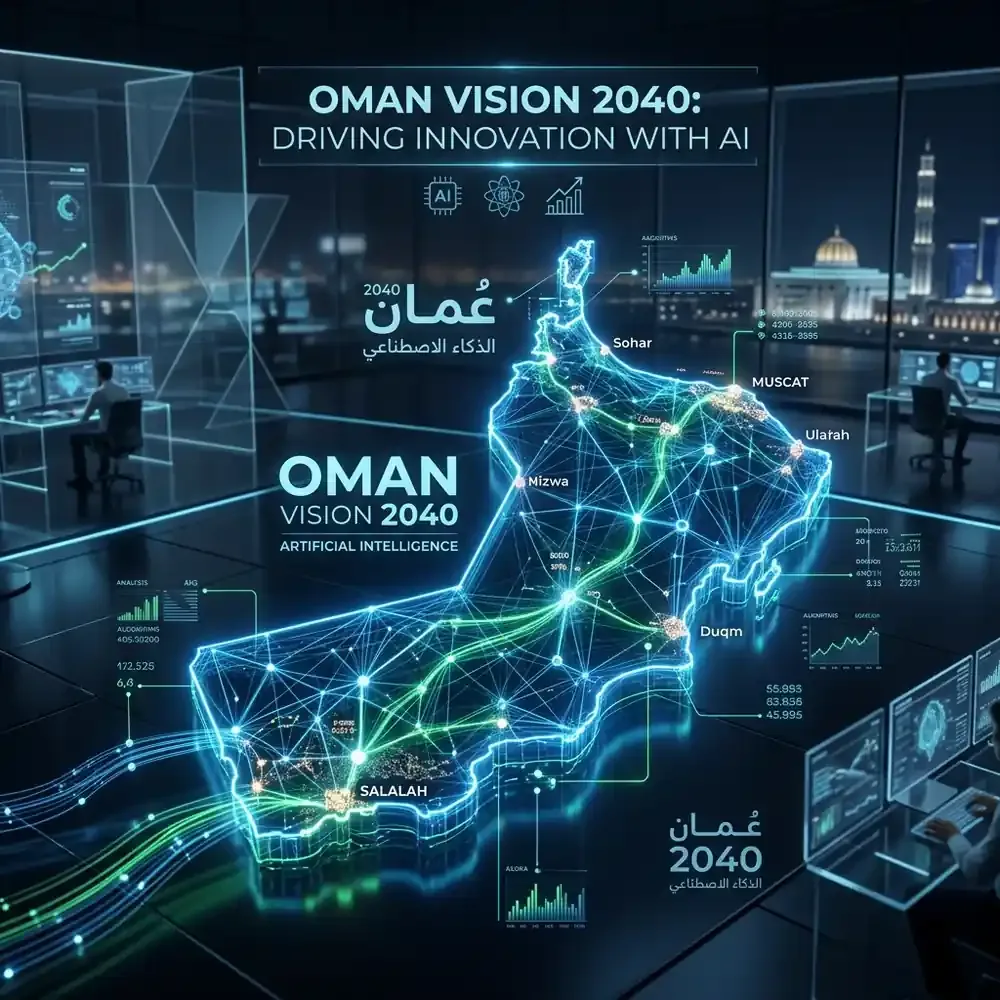
The Sultanate of Oman is executing an aggressive pivot from a petroleum-dependent economy to a knowledge-based technological powerhouse. Anchoring this transformation is Oman Vision 2040, a definitive roadmap detailing strict national key performance indicators (KPIs). As we navigate through 2026, Artificial Intelligence (AI) and automation are no longer optional tools for GCC businesses—they are state-mandated utilities shaping corporate survival.
With recent legislative milestones, such as Royal Decree 50/2026 establishing the Muscat AI Special Zone, the government is incentivizing early tech adopters while heavily penalizing analog stagnation. Understanding these objectives isn't just about civic duty; it is a financial necessity for securing government tenders, subsidies, and sustained growth.
How does AI automation directly fulfill the National Objectives of Oman Vision 2040?
AI achieves Vision 2040 objectives by automating 70% of redundant government and private-sector administrative tasks, facilitating a 35% increase in cross-sector operational efficiency, and reducing reliance on manual expatriate labor to support the national In-Country Value (ICV) metrics.
The core philosophy of Vision 2040 is economic diversification. Historically, the private sector's growth was heavily subsidized by oil revenues. To decouple from this volatility, Oman must optimize output. AI systems directly address this by cutting operational friction. When an Omani SME deploys a WhatsApp AI Receptionist to handle client onboarding, they bypass the cost of human resources while guaranteeing a 0% error rate in data collection.
According to the National Program for Digital Economy, enterprises that transition to automated workflows experience a dramatic drop in overhead. This capital is then reallocated to research, localized manufacturing, and skill development—all primary KPIs of the national vision. By adopting AI, you are algorithmically aligning your balance sheet with the nation's GDP targets.
What are the core KPIs Oman Vision 2040 sets for corporate digital transformation?
The framework mandates that private enterprises transition 35% of their core workflows to digital environments by 2030, achieve a 90% non-oil GDP contribution, and ensure 15% ICV compliance in all IT infrastructure developments to qualify for national subsidies.
Corporate ambiguity is effectively dead. The MTCIT (Ministry of Transport, Communications and Information Technology) measures corporate health not just by profit, but by digital agility. Companies are evaluated based on their data infrastructure. Utilizing predictive models, cloud automation platforms like n8n or Make.com, and localized Large Language Models (LLMs) like Oman GPT directly impacts your vendor score.
| Digital Transition Metric | 2024 Baseline | 2026 Target | Vision 2040 Goal |
|---|---|---|---|
| Enterprise Workflow Automation | 12% | 25% | 75% |
| AI Customer Service Integration | 8% | 30% | 90% |
| Non-Oil GDP Contribution | 68% | 75% | 90%+ |
| Data Localized on GCC Servers | 20% | 45% | 100% |
Meeting these KPIs requires structural overhauls. Business managers cannot rely on fragmented excel sheets. Real-time data synchronization using APIs is the fundamental requirement for participating in the 2026 economy.
Which industries in Oman are prioritized for immediate AI integration by 2026?
Logistics, Energy (Oil & Gas), and Finance are the apex priorities. By 2026, logistics firms utilizing predictive AI routing will see a 22% cost reduction, while energy sectors are mandated to integrate automated safety monitoring and extraction optimization.
The Sultanate's geographical positioning makes it a premier logistics hub. AI automation directly impacts the supply chain. From automated inventory forecasting to autonomous crane operations in the Port of Salalah, machine learning eliminates the human bottleneck. Furthermore, the Oil & Gas sector is deploying specialized autonomous AI agents to predict equipment failure weeks before a pipeline burst, saving millions of Rials in downtime.
For SMEs, this means providing B2B services to these giants requires deep API integration. If your local firm supplies parts to a major logistics company, your invoicing, stock updates, and communication must be automated. The giants will not wait for manual PDF invoices; they demand instant JSON webhook responses.
How can SMEs leverage government AI frameworks to increase local market share?
SMEs can dominate by utilizing government-subsidized AI sandboxes in Muscat to develop bespoke solutions, drastically lowering R&D costs by 40% and offering faster, zero-error localized services that outcompete slower, legacy corporate entities.
The true beneficiaries of Vision 2040 are agile SMEs. While massive corporations take years to approve a software transition, a 10-person agency can deploy a fully automated CRM, AI lead generation system, and 24/7 WhatsApp AI responder within a single weekend. The Omani government provides grants and infrastructure (like Oman GPT APIs) specifically to encourage this agility.
"In the Vision 2040 framework, the size of a company no longer dictates its output. A highly automated SME with three employees can execute the workload of a fifty-person legacy firm." — AI Profit Lab Market Analysis
By consulting Oman.om's e-government resources and utilizing OpenAI's infrastructure, local businesses can build sophisticated, ICV-compliant automation stacks that instantly elevate their market positioning.
What are the potential penalties for failing to adopt Vision 2040 compliance standards?
Failure to digitize results in exclusion from government tenders, a 15% reduction in ICV vendor scoring, increased taxation scrutiny, and absolute market irrelevance as competitors leverage AI to drop prices by 30% while increasing service speed.
Oman is actively phasing out analog reliance. The hidden tax of ignoring AI is operational bloat. If you require five human employees to process customer data while your competitor uses a single automated Python script, your profit margins will disintegrate. You will be forced to charge higher prices for slower service. In an economy driven by the aggressive metrics of Vision 2040, technological stagnation is fatal.
Ready to Align with Vision 2040?
Stop losing market share to tech-savvy competitors. Connect with AI Profit Lab to deploy compliant, high-ROI automation frameworks directly into your Omani business operations.
Book Your Free AI Audit