

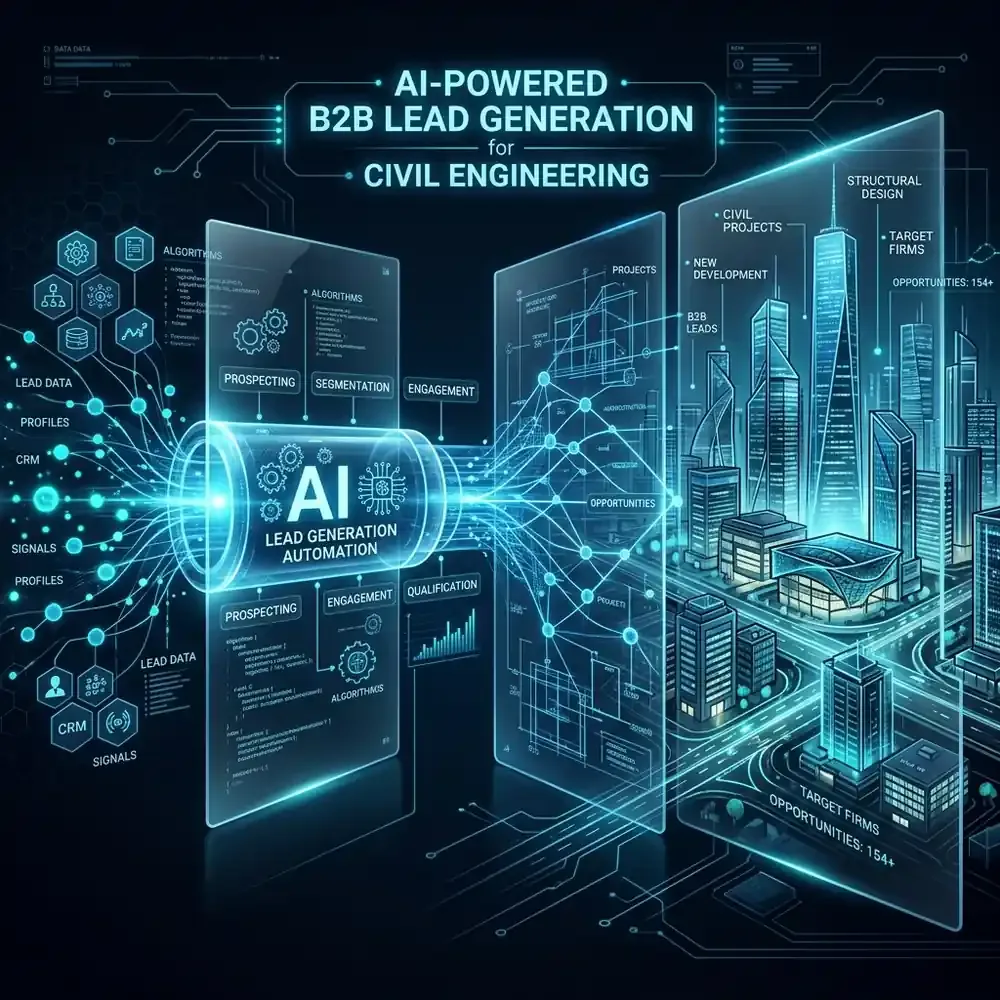
The Silent Crisis in Civil Engineering Growth
Let’s start with a brutal reality check: most civil engineering firms are operating their business development like it’s 2012. You rely on referrals, networking events, and perhaps a junior associate spending hours manually scouring municipal websites or LinkedIn for signs of new commercial developments.
I spoke with the managing partner of a mid-sized structural engineering firm last month. His team was spending nearly $100 per hour just in payroll costs to have highly trained engineers do manual data entry and "prospecting." That is a catastrophic misallocation of resources. The result? A pipeline that fluctuates wildly between feast and famine, heavily dependent on the personal networks of a few senior partners.
"We missed out on a massive multi-use complex downtown simply because we found out about it two months after the initial feasibility studies were already awarded to a competitor. We were reacting, not hunting."
This is where B2B lead generation automation comes in. It’s not about sending spammy emails. It’s about building a deterministic, highly structured machine that detects early-stage project signals, scrapes verified contact data, and initiates personalized outreach before your competitors even know the project exists. Here is the exact framework to automate your firm's growth.
Phase 1: Automating the Scraping Process
TL;DR: Stop manually searching. Use AI scrapers and API integrations to pull data from city planning minutes, tender portals, and real estate news the second they go live.
In civil engineering, you aren't just selling to a "persona"—you are selling to a project. Your trigger events are zoning approvals, land acquisitions, and early feasibility studies. If you wait for an official RFP to drop, you’re already too late.
How to Build Your Data Engine
Instead of manually checking websites, modern firms use customized web scrapers and intent-data tools. Platforms like Building Radar or custom Python scrapers can monitor hundreds of municipal portals simultaneously. When a keyword like "commercial rezoning" or "mixed-use development" appears in city council meeting minutes, the system instantly flags it.
Once a project is flagged, the next step is identifying the Buying Committee. A commercial development isn't greenlit by one person. You need to map out the developer, the lead architect, and the financiers. Automated tools like ZoomInfo or Apollo.io can take the name of the development firm and instantly output the verified emails and direct-dial phone numbers of the key stakeholders. No more guessing email formats.
Cost Comparison: Manual vs. Automated Scraping
| Metric | Manual Prospecting | AI Automated Scraping |
|---|---|---|
| Time to Find 100 Leads | 15 - 20 Hours | 5 Minutes |
| Cost Per Verified Lead | ~$84.00 | $0.02 - $0.50 |
| Data Decay Rate | High (Human Error) | Near Zero (Auto-refresh) |
Phase 2: The Qualification Engine (Lead Scoring)
TL;DR: Don't treat every lead equally. Use AI to assign scores based on firmographic data, ensuring your senior partners only talk to high-probability prospects.
Generating a list of 5,000 developers is useless if 4,900 of them build single-family homes and your firm specializes in high-rise structural engineering. This is where automated qualification becomes critical.
When your scraping engine pulls a lead into your CRM (like HubSpot or Salesforce), an AI layer evaluates the data against your Ideal Customer Profile (ICP). It looks at:
- Firmographics: Is the target company generating over $50M in annual revenue?
- Technographics: Are they using advanced BIM software (indicating a sophisticated operation)?
- Recent News: Did they just secure a massive round of funding or announce a new regional headquarters?
The system assigns a Lead Score. If a lead scores above a 90, it’s immediately routed to a senior partner via a Slack or Microsoft Teams notification. If it scores a 50, it enters a long-term educational nurture sequence. This ensures that expensive human time is only spent on deals with a high probability of closing.
Phase 3: Hyper-Personalized Automated Outreach
TL;DR: Blanket cold emails will ruin your reputation. Use AI to dynamically insert personalized opening lines based on the prospect's recent activity.
Let me be incredibly clear: sending the exact same "We are a premier civil engineering firm..." email to 1,000 people will get your domain blacklisted. The modern approach is scaled personalization.
Using tools like Instantly, Smartlead, or custom AI scripts, you can automate a multi-channel outreach sequence. But the magic is in the prompt engineering. You can feed the prospect's LinkedIn profile or recent company press release into an LLM (like GPT-4), and have it generate a hyper-specific opening line.
The Perfect Outreach Sequence
A highly effective automated sequence looks like this:
- Day 1 (LinkedIn): Automated profile view and connection request. No pitch, just: "Hi [Name], saw your team's recent approval for the [Project Name] downtown. Impressive work getting through zoning. Would love to connect."
- Day 3 (Email): The "Soft Value" email. "Given your upcoming commercial build in the West End, I thought this case study on how we reduced foundation costs by 18% on a similar soil profile might be useful."
- Day 7 (Email): The direct ask. "Are you open to a brief 10-minute chat to see if our structural team could alleviate some of the timeline pressure on the [Project Name]?"
This entire process happens automatically in the background. Your team only steps in when a prospect replies saying, "Yes, let's talk."
The Speed to Lead Advantage
Finally, we need to talk about inbound automation. When a prospect fills out a form on your website requesting a consultation, how long does it take your team to reply? If the answer is "the next business day," you are losing millions.
Data shows that firms responding within one hour are seven times more likely to qualify the lead. Implement an AI-driven chatbot or automated scheduling link (like Calendly) directly in your form confirmation. When a high-value prospect reaches out, the system should automatically check your team's calendar and offer them a meeting slot immediately. Friction kills deals; automation removes friction.
The Bottom Line
B2B lead generation automation is no longer a luxury reserved for Silicon Valley SaaS companies. For civil engineering firms, it is the difference between a reactive business struggling through economic downturns, and a proactive powerhouse with a predictable, scalable pipeline. Once project contracts are won, contractors can further protect project profit margins by deploying AI automation for construction site workflows, RFIs, and material procurement in Muscat. It's time to let AI do the heavy lifting so your engineers can get back to building.