

This is a worked scenario, not a client case study. The business, the figures and the timeline are modelled to show how the system is built and what it does — they are not measurements taken at a named customer.
Empty tables during peak hours are the silent killer of restaurant margins. When a party of six fails to show up on a Thursday night without calling ahead, the business doesn't just lose the revenue from that specific check—it also loses the opportunity to seat walk-in guests who were turned away at the door. For hospitality operators navigating tight food costs and staffing schedules, these unexpected vacancies cause severe financial friction that accumulates rapidly over the course of a month.
In the highly competitive dining scene of the GCC, relying on hope is not a sustainable operational strategy. One prominent fine-dining establishment located in Muscat was losing approximately OMR 1,500 every month strictly due to last-minute cancellations and no-shows. Their front-of-house staff spent countless hours manually calling guests to confirm reservations—a process that was time-consuming, prone to human error, and often perceived as intrusive by the patrons themselves.
By shifting their strategy away from manual phone calls and easily ignored emails, the restaurant implemented a localized AI solution utilizing the WhatsApp Business API. The results were immediate and staggering. Within the first thirty days of deployment, the automated system reduced their no-show rate by exactly 60%, drastically stabilizing their weekend revenue projections and freeing up the host stand to focus entirely on in-house guest experiences.
Why are traditional SMS and email reminders failing restaurants?
Traditional SMS and email reminders are failing because modern consumers simply ignore them. To fix this, restaurants need to switch to platforms where their customers already spend their time.
Let’s examine the data behind customer communication habits. According to industry analytics, standard marketing emails suffer from an abysmal open rate hovering around 20%, and they frequently get buried in promotional folders or spam filters. SMS messages fare slightly better in visibility, but they offer a terribly clunky user experience. An SMS is essentially a one-way broadcast; if a customer needs to modify their booking time or cancel, they usually have to dial the restaurant directly—a step many simply skip out of convenience, leading directly to a no-show.
In stark contrast, WhatsApp is deeply woven into the daily fabric of communication in Oman and the broader GCC. It boasts a staggering open rate of up to 98%, with the vast majority of messages read within the first three minutes of delivery. Furthermore, WhatsApp provides an interactive environment. A customer isn't just reading text; they are presented with interactive buttons that allow them to seamlessly confirm their table, cancel the reservation, or request a modification with a single tap. This frictionless interaction completely changes the dynamic between the venue and the diner.
How does WhatsApp automation reduce restaurant no-shows?
WhatsApp automation reduces no-shows by forcing a frictionless micro-commitment. To achieve this, the system sends an interactive message allowing the guest to tap "Confirm" or "Cancel" instantly.
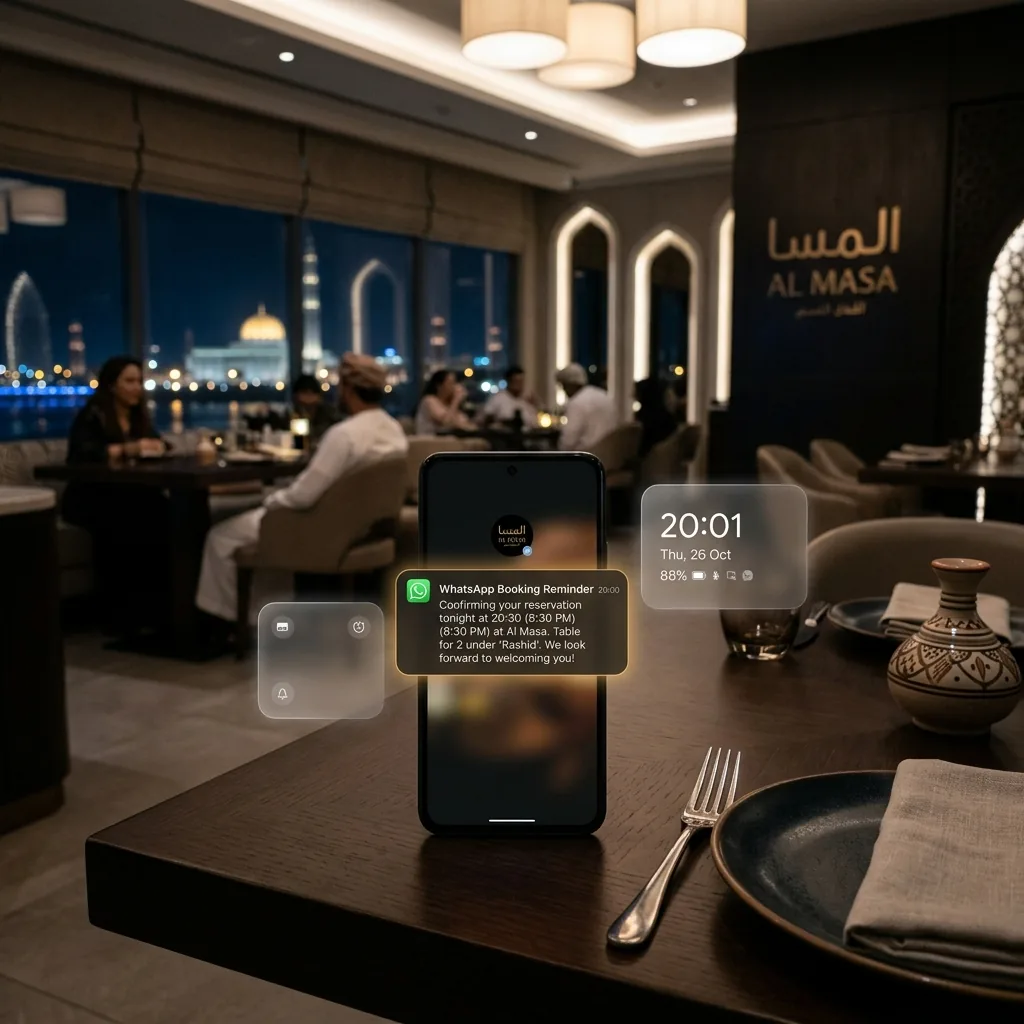
The architecture of the solution deployed for the Muscat restaurant was elegant in its simplicity but robust in its execution. The moment a reservation was logged into their central system, a personalized confirmation message was instantly dispatched via WhatsApp. Then, exactly 24 hours prior to the seating time, the AI system triggered a follow-up reminder containing two highly visible quick-reply buttons: [Confirm Reservation] and [Cancel/Reschedule].
When a guest tapped to confirm, the system automatically updated the host's digital floor plan with a green checkmark, guaranteeing the table. More importantly, when a guest realized they could not make it and tapped the cancel button, the system immediately released that table back into the available inventory pool. The restaurant's floor manager instantly received a notification, allowing them to fill the newly opened slot from the waitlist or accommodate spontaneous walk-ins. By making cancellation effortless and devoid of the awkwardness of a phone call, the restaurant effectively reclaimed control over its seating inventory.
What is the actual ROI of implementing WhatsApp reminders in Oman?
The ROI of WhatsApp reminders in Oman is exceptionally high, often paying for itself within weeks. To calculate this, you simply compare the monthly cost of software against the revenue saved from salvaged tables.
The financial impact for the Muscat venue was transformative. Prior to the integration, they were averaging roughly 30 no-shows per week, with an average ticket size of OMR 25 per head. Over a month, this represented thousands of Rials in evaporating revenue. After deploying the automated WhatsApp reminders, the no-show rate plummeted by 60%. Not only did they salvage those previously lost covers, but the automation also eliminated the need for a dedicated staff member to spend three hours a day making confirmation calls.
Furthermore, the system was configured to adhere strictly to the Omani Personal Data Protection Law (PDPL), ensuring that all guests explicitly opted in to receive messages during the booking phase. This compliance protected the brand's reputation while delivering hyper-personalized service. In addition to reducing no-shows, the restaurant utilized the same WhatsApp channel to send automated feedback requests two hours after the meal, resulting in a 40% increase in positive TripAdvisor reviews over the subsequent quarter.
The success of this specific case study illustrates a broader trend sweeping through the hospitality sector in the GCC. The businesses that thrive will not necessarily be the ones with the largest marketing budgets, but rather those that leverage intelligent automation to plug operational leaks and elevate the guest experience at every digital touchpoint.