
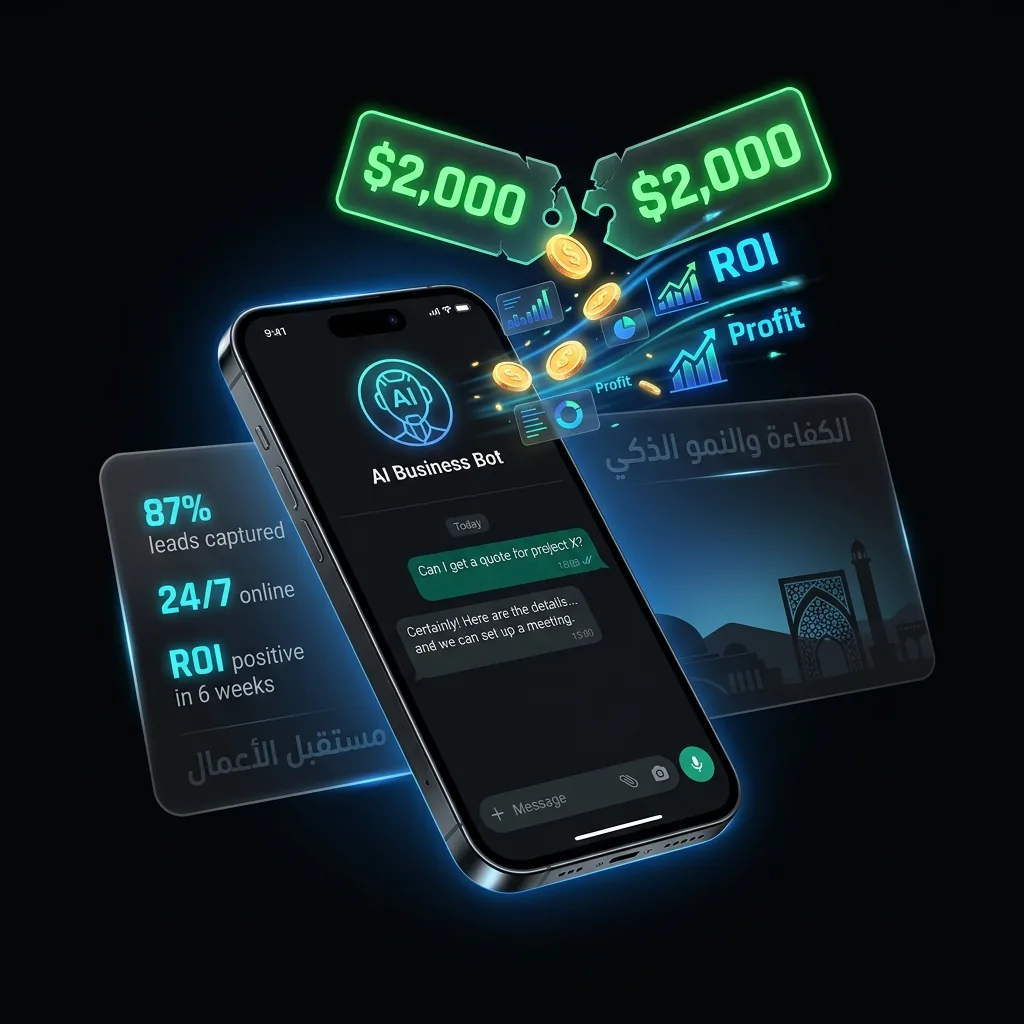
Every week, business owners across Muscat, Sohar, and Salalah get pitched a version of the same promise: pay us around $2,000 and we will build you a WhatsApp AI receptionist that answers leads 24 hours a day, books appointments, and saves you from ever missing a message again. Some of them are getting exactly that. Others are paying for an expensive keyword bot dressed up in AI clothing. This breakdown helps you tell the difference — before you transfer the money.
What Does $2,000 Actually Buy You in a WhatsApp AI Receptionist?
A $2,000 WhatsApp AI receptionist is the genuine article when it delivers all of the following without exceptions or asterisks: natural language understanding (not keyword matching), seamless Arabic and English handling with code-switching support, integration with your existing booking platform or CRM, custom conversation flows designed around your actual business scenarios, WhatsApp Business API setup through an approved Meta Solution Provider, and a minimum of 30 days of post-launch support and bug-fixing.
"The deliverable is not the bot. The deliverable is the leads it captures, the appointments it books, and the staff hours it saves. If you cannot measure those three things, you do not have a $2,000 AI receptionist — you have a $2,000 FAQ page."
For context, a professionally configured WhatsApp AI receptionist at this price tier typically involves 40–60 hours of build time across conversation design, API integration, testing across edge cases, and staff training. If a provider quotes $2,000 and claims they can deliver in three days with minimal discovery, that is your first red flag.
What Is the Real ROI You Should Expect Within 90 Days?
The ROI of a WhatsApp AI receptionist is measurable through four distinct channels. First, lead capture rate: a business in Muscat receiving 30 WhatsApp inquiries per day — common for real estate agencies, clinics, and automotive workshops — typically sees 20–30% of those messages arrive outside office hours. If your AI receptionist captures even 60% of that after-hours traffic and qualifies them into the pipeline, you are recovering leads that previously went to your competitor who replied first. In Oman's high-competition sectors, responding within 5 minutes increases conversion probability by 400% compared to a next-morning reply.
Second, staff time: a trained receptionist in Muscat costs approximately 300–450 OMR per month in salary plus benefits. A WhatsApp AI receptionist handling 60–70% of inbound volume allows that receptionist to focus entirely on relationship-sensitive conversations — effectively doubling their output without adding headcount. Third, appointment no-shows: automated reminder sequences sent via WhatsApp 24 hours and 2 hours before appointments reduce no-show rates by 35–50% in Omani clinics and service businesses, a direct revenue recovery. Fourth, after-hours revenue: one additional converted lead per day at an average deal size of 50 OMR pays back the entire $2,000 investment in under 40 days.
90-Day ROI Snapshot — Muscat Real Estate Agency Example
At a 15% lead-to-client conversion rate and average commission of 500 OMR per deal: ~5 new clients per month attributable to the AI receptionist = 2,500 OMR monthly uplift. Investment recovered in under 4 weeks.
When Is $2,000 NOT Worth It for Your Business?
Not every business in Oman and the GCC benefits equally from a WhatsApp AI receptionist at this price point. Be honest with yourself about three criteria. Volume: if you receive fewer than 15 WhatsApp inquiries per day, a $2,000 AI receptionist is likely over-engineered. A simpler, lower-cost automation will serve you better. Conversion value: if your average transaction is below 20 OMR, the math rarely works at this setup cost — look at entry-level packages in the 150–300 OMR range instead. Readiness: if you do not have a CRM, a defined follow-up process, or anyone monitoring escalated conversations, the AI will capture leads that disappear into a void. The technology works — but it requires an operational foundation to deliver ROI.
How Do You Spot a Cheap Bot Disguised as an AI Receptionist?
The GCC market — including Oman, UAE, and Saudi Arabia — has seen a wave of vendors selling keyword bots rebranded as "AI-powered solutions" since 2024. The tell-tale signs are consistent. The demo works perfectly on the exact phrases the vendor typed, but breaks the moment you phrase a question differently. The system cannot handle an Arabic message followed by an English follow-up. There is no escalation logic — a customer asking "I need to speak to someone urgently" gets the same FAQ response as "what are your opening hours?" The vendor cannot show you where the AI model lives — because there is no AI model, only an if-then decision tree.
Under Oman's Personal Data Protection Law (PDPL, Royal Decree 26/2023), any system collecting customer WhatsApp numbers and inquiry data must have documented consent mechanisms and a data retention policy. A vendor who cannot explain where your customer data is stored — whether inside Oman through Omantel's infrastructure or in overseas servers — is exposing you to compliance risk that Oman's Information Technology Authority (ITA) is increasingly enforcing in 2026.
What Should You Demand in the Contract Before Paying?
Before transferring funds for any WhatsApp AI receptionist project in the GCC, your contract must specify: the exact number of conversation flows to be built and tested; the API connections included (booking system, CRM, calendar); Arabic and English language coverage with example test transcripts; escalation logic documentation; data storage location and PDPL compliance statement; post-launch support duration and response SLA; and a performance benchmark — for example, the AI must successfully resolve at least 70% of test queries without human escalation before the project is considered delivered. Any reputable provider working in Muscat or broader Oman will agree to these terms without pushback. Hesitation on any of these points is your cue to walk away.
Vision 2040 in Oman explicitly targets SME digitisation and AI adoption as a core pillar of the country's economic diversification strategy. The ITA's Ma'een AI initiative and Omantel's otech sovereign cloud investments signal that AI infrastructure in Oman is maturing rapidly. Businesses that deploy well-built AI customer engagement systems today are positioning themselves ahead of a curve that will be far more crowded — and expensive — by 2027. The $2,000 investment is not just an operational tool; for businesses aligned with Oman's digital transformation agenda, it is a strategic differentiator.