
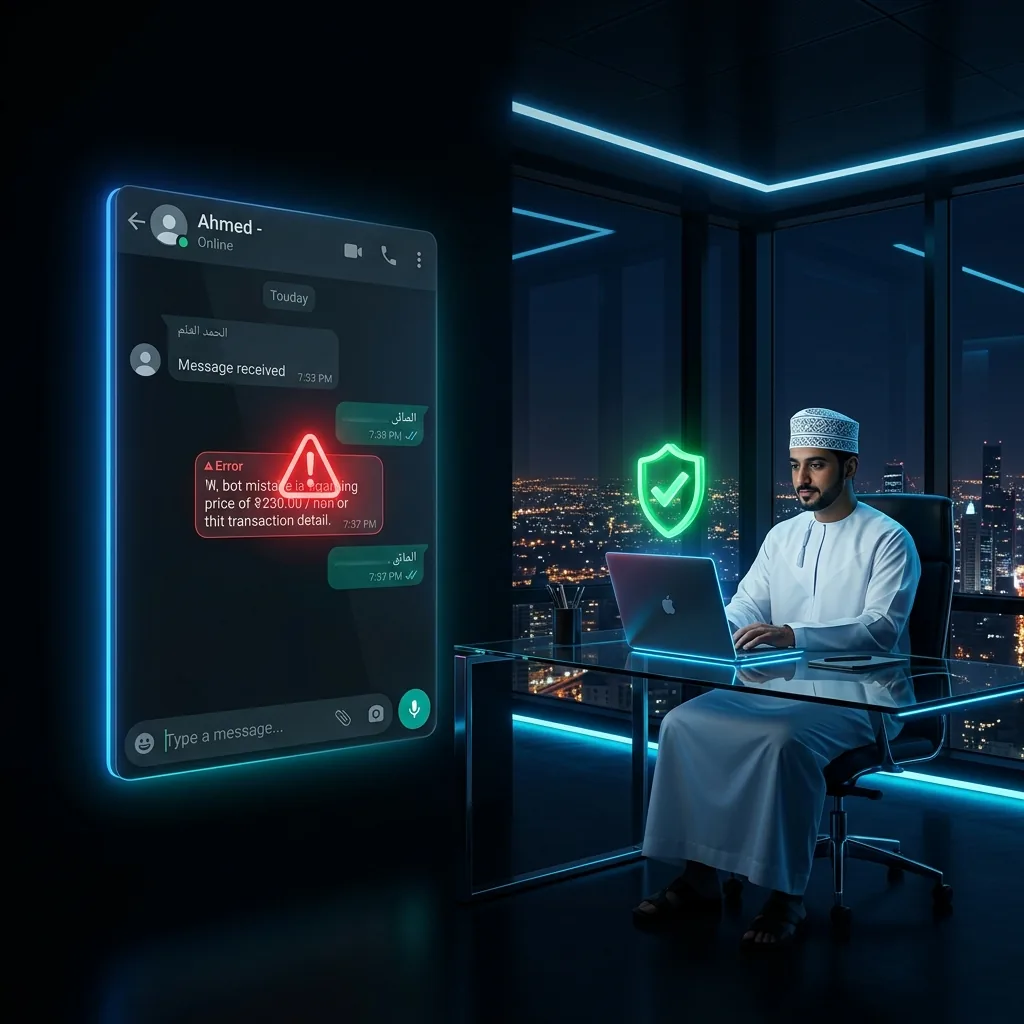
A restaurant owner in Muscat told us his WhatsApp AI once confirmed a table booking for Saturday — except the restaurant was closed for a private event that day. The bot had no idea. It processed the request, sent a confirmation, and the customer showed up. That kind of mistake costs more than just one dissatisfied diner. It costs the trust that took years to build.
WhatsApp AI bots are now handling thousands of customer conversations every day across Oman, the UAE, and Saudi Arabia. They book appointments, answer pricing questions, qualify leads, and handle after-hours inquiries. Most of the time, they work brilliantly. But when they don't — and they will make mistakes — the impact can be immediate, public, and expensive.
This article is not about fear-mongering AI. It's about giving business owners in the GCC a realistic picture of what goes wrong, why it happens, and what a properly engineered system does to catch and prevent errors before they reach your customers.
What Are the Most Common WhatsApp AI Errors in GCC Businesses?
WhatsApp AI errors in GCC businesses are primarily caused by three categories: outdated data being served to customers, poor dialect understanding of Gulf Arabic, and missing human escalation paths. Each one is preventable with the right architecture.
1. Wrong Price Quotes: This is the most frequent and most damaging error. If your bot's pricing is hardcoded into the conversation flow — rather than pulled from a live database — any price change you make in your system won't reflect in what the bot tells customers. A clinic in Salalah experienced this firsthand when they updated their consultation fees in February but forgot to update the bot script. For six weeks, patients were quoted the old price and then surprised at the front desk. The fix: always connect your WhatsApp AI directly to your pricing database or Google Sheet, never hardcode numbers.
2. Gulf Arabic Dialect Mismatches: Standard Arabic NLP models are trained predominantly on Modern Standard Arabic (فصحى) and Egyptian dialect. Omani, Emirati, and Saudi Khaleeji spoken patterns are significantly different. Customers type phrases like "وين الفرع؟" or "كم قيمته؟" and a poorly calibrated bot either misunderstands the intent or responds in awkward formal Arabic that feels robotic. A study of GCC chatbot interactions found that approximately 34% of dialect-heavy messages were misclassified by models not fine-tuned for the region. The fix: use a GCC-aware Arabic NLP layer, or pre-process incoming text to normalize dialect before intent recognition.
3. Double-Booking and Calendar Conflicts: This is almost always a technical integration failure. The bot confirms a slot without checking real-time calendar availability — because the calendar integration is broken, delayed, or not set up at all. The result: two customers booked for the same time, and an embarrassed front desk staff member making two phone calls. The fix: WhatsApp bookings must trigger a real-time API call to your calendar system (Google Calendar, Zoho Bookings, or your PMS) and only confirm when a slot is verified as open.
4. Failure to Escalate Urgent Situations: A customer who types "I need to speak to someone NOW" or "this is an emergency" should never receive a bot response. Yet poorly configured systems continue to serve FAQ answers when a human is desperately needed. Under Oman's customer protection expectations and general GCC business norms, failing to route urgent matters to a live agent is a serious service failure. The fix: build explicit escalation triggers — keyword lists, sentiment analysis, or a simple "speak to agent" button — that hands control to a human immediately.
How Do You Build a WhatsApp AI That Catches Its Own Mistakes?
To build a mistake-catching WhatsApp AI, you need three mechanisms: a confidence threshold that prevents the bot from guessing, a human fallback that activates when uncertainty is detected, and a logging system that records every conversation for review.
The concept of a confidence threshold is critical and underused. Every response your AI generates has an internal confidence score — essentially how certain the model is that it understood the request correctly. A well-configured system sets a minimum threshold of around 80–85%. If the AI's confidence drops below that (because the question is ambiguous, out-of-scope, or written in a dialect it doesn't recognize), it should not attempt an answer. Instead, it should say: "I want to make sure I give you the right information — let me connect you with our team."
This single mechanism — when properly implemented — eliminates the majority of confident-but-wrong answers that damage customer relationships.
"The most dangerous AI bot is the one that answers confidently when it shouldn't answer at all."
Logging and weekly audits are the second layer of defense. Every conversation your bot handles should be stored in a searchable log. Once a week, review 20–30 random conversations. Look for: responses where a customer had to repeat themselves more than twice, conversations where the customer went silent after the bot responded (a sign of frustration), and any chat where a customer explicitly expressed dissatisfaction. In our experience working with Omani SMEs, these weekly reviews consistently surface 3–5 fixable issues per month that would otherwise silently erode customer experience.
Does Oman's PDPL Law Create Legal Risk When Your WhatsApp AI Fails?
Yes, Oman's Personal Data Protection Law (PDPL) under Royal Decree 6/2022 creates direct legal obligations for businesses using WhatsApp AI. If your bot collects, stores, or processes customer data incorrectly — including through a malfunction — you may be in breach of your data handling obligations under the law.
Specifically, if an AI error causes the wrong customer's data to be disclosed to another party — for example, sending order details to the wrong WhatsApp number — this constitutes a data breach under the PDPL. The Oman National CERT and the relevant regulatory authority can impose fines and require mandatory notification. This is not theoretical: several regional businesses across the GCC have faced compliance reviews after AI-related data incidents.
The practical implications for your WhatsApp AI system: customer data collected through the bot must be stored in Oman or in a jurisdiction with equivalent data protection standards, retention periods must be defined and enforced, and customers must be able to request deletion of their data. A properly built system handles all of this automatically — but a poorly assembled bot almost certainly does not.
What Is the Cost of a WhatsApp AI Mistake vs. the Cost of Prevention?
The cost of a WhatsApp AI mistake is far greater than the cost of prevention. A single wrong price quoted to 50 customers can create disputes worth hundreds of OMR. Prevention through proper architecture costs a fraction of that.
Here's a realistic breakdown for Omani businesses. Remediating a broken WhatsApp bot — rebuilding flow logic, retraining intent models, reconnecting database integrations — typically costs between OMR 150 and OMR 500 depending on scope. But the hidden costs are larger: refunds issued to customers who were quoted the wrong price, staff time spent manually apologizing and correcting errors, and the reputational damage of negative Google or WhatsApp reviews.
By contrast, a properly architected WhatsApp AI system — built with live database connections, confidence thresholds, human escalation paths, and weekly audit routines — costs approximately OMR 250–400 per month as a managed service in Oman. This includes ongoing monitoring, regular retraining, and error resolution as part of the package. The math is clear: prevention is not just safer, it's significantly cheaper.
For context, a growing number of Omani businesses under Vision 2040's digital economy mandate are now treating AI quality assurance as a business-critical function — not an optional add-on. Sohar Industrial Port's logistics suppliers, Muscat-based hospitality chains, and retail groups in Qurum are all implementing formal AI audit processes as part of their digital transformation roadmaps.