
The dental industry is undergoing a silent revolution. While the physical tools—drills, chairs, and mirrors—remain familiar, the intelligence powering the clinic has evolved. In 2026, **AI automation** is transforming dentistry from a manual, high-friction profession into a data-driven, high-precision healthcare service.
For dental clinic owners in Oman and across the GCC, the adoption of AI is not just about keeping up with technology; it's about solving the three biggest challenges in the industry: **clinical accuracy, administrative overhead, and patient trust.**
1. Precision Diagnostics: The "Second Pair of Eyes"
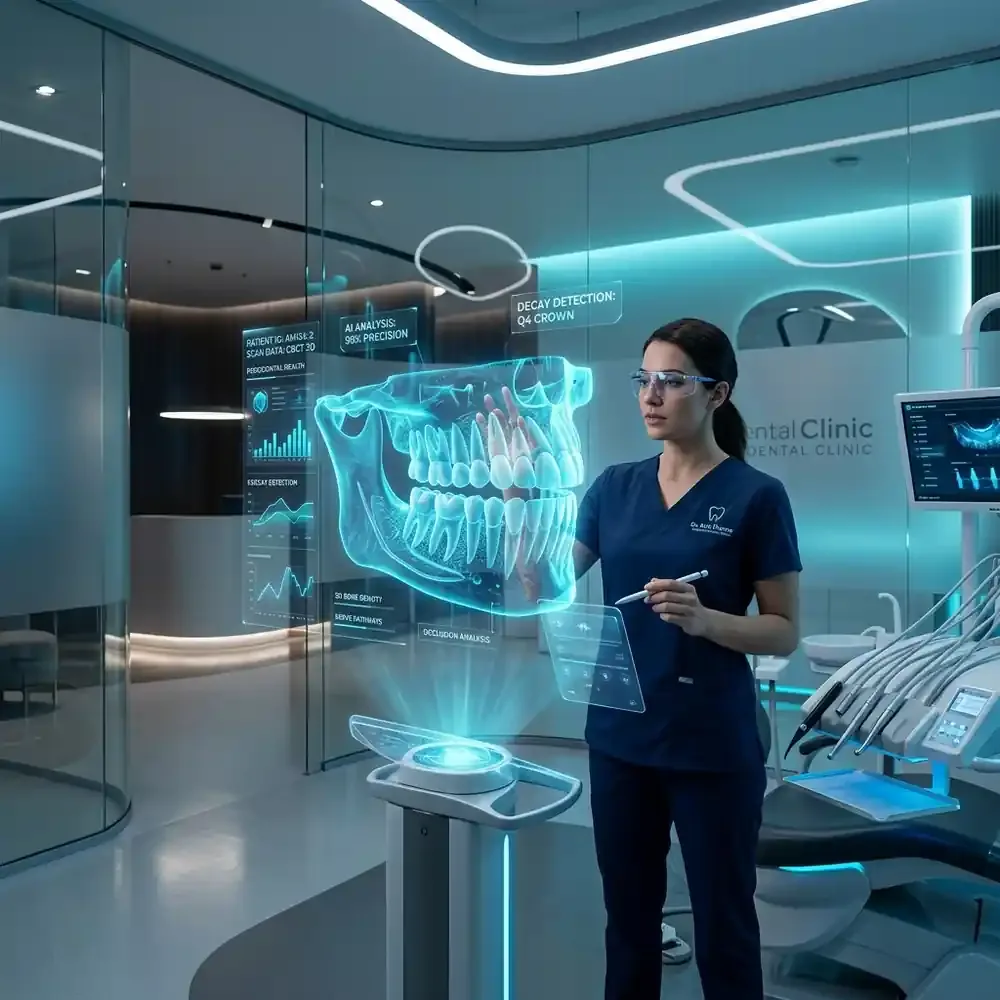
One of the most impactful applications of AI in dentistry is in image analysis. AI algorithms, trained on millions of radiographs and 3D scans, can now detect pathologies with a level of consistency that exceeds even the most experienced clinicians during a busy shift.
AI-powered diagnostic tools can automatically flag:
- Early-stage caries: Detecting decay before it's visible to the naked eye.
- Bone loss: Tracking periodontal disease with millimetre precision.
- Periapical lesions: Identifying infections in root canals that might be missed on standard 2D X-rays.
By providing a "second opinion" in real-time, AI reduces diagnostic errors and gives patients the confidence that their treatment plan is based on objective, data-backed evidence.
"AI doesn't replace the dentist's expertise; it amplifies it. It ensures that no detail, however small, is overlooked."
2. Automating the "Paperwork" (Administrative Efficiency)
The average dental clinic spends up to 40% of its time on non-clinical tasks. From insurance verification to patient scheduling, the administrative burden is a major drain on profitability. AI automation is reclaiming this time.
Smart Scheduling & No-Show Prediction
AI tools can analyze historical patient behaviour to predict who is likely to miss an appointment. The system can then automatically send personalized reminders or offer "last-minute" slots to patients on a waiting list, ensuring the operatory chairs are always full.
Revenue Cycle Automation
Billing and insurance claims are notoriously slow. AI-driven revenue management systems can verify insurance eligibility instantly, code procedures accurately, and flag potential claim rejections before they are submitted. This accelerates cash flow and reduces the "back-and-forth" with insurers.
3. Enhancing Patient Experience and Trust
Patient "fear of the dentist" is often rooted in a lack of understanding. AI helps bridge this gap through visualization and transparency.
- Smile Design & Simulations: AI can generate realistic "before and after" simulations for cosmetic procedures, allowing patients to see their future smile before the first procedure begins. This significantly increases treatment acceptance rates.
- 24/7 AI Receptionists: Instead of patients waiting for business hours to book an appointment, AI chatbots and voice assistants can handle inquiries, book slots, and answer routine questions at 3 AM.
- Transparent Treatment Planning: When a patient sees an AI-generated chart highlighting a cavity in bright red, the "need" for treatment becomes undeniable. It removes the perceived bias of the dentist trying to "sell" a procedure.
4. The ROI of Dental AI
Implementing AI automation is a strategic investment. The return on investment (ROI) comes from multiple streams:
Clinic Performance: Manual vs. AI-Automated
| Metric | Manual Practice | AI-Automated Clinic |
|---|---|---|
| Diagnostic Speed | 5-10 minutes / case | < 30 seconds |
| Admin Time / Day | 4-6 hours | < 2 hours |
| Treatment Acceptance | ~45% | > 70% (via visualization) |
| Patient Retention | Standard | High (due to 24/7 engagement) |
5. Teledentistry and Remote Monitoring
AI is also extending the clinic's reach beyond its walls. Patients can now use smartphone apps to take photos of their teeth, which are then analyzed by AI to monitor the progress of orthodontic treatments (like Invisalign) or to triage emergencies. This reduces unnecessary clinic visits while keeping the patient closely monitored.
Conclusion: The Clinic of the Future, Today
In 2026, the question for dental clinic owners is no longer *if* they should adopt AI, but *how fast* they can integrate it. AI automation is the ultimate tool for scaling a practice without increasing stress or headcount.
At **AI Profit Lab**, we help healthcare providers in Oman and the GCC navigate this transition. We build the "digital nervous system" for your clinic—connecting your diagnostics, scheduling, and patient communication into one seamless, automated engine.
Ready to modernize your clinic and boost your margins? Contact us today for a custom AI automation roadmap.
Clinic Owner's Insight
"Since integrating AI diagnostics and automated scheduling, our treatment acceptance has jumped by 30%. Patients feel more involved when they see the AI-powered simulations, and my staff is no longer buried in paperwork. It's a win for everyone."