AI Automation in Oman: 2025 Guide for Business Owners
Vision 2040 is not a future goal — it is today's competitive pressure. Here is how Omani businesses are using AI automation to survive and scale.
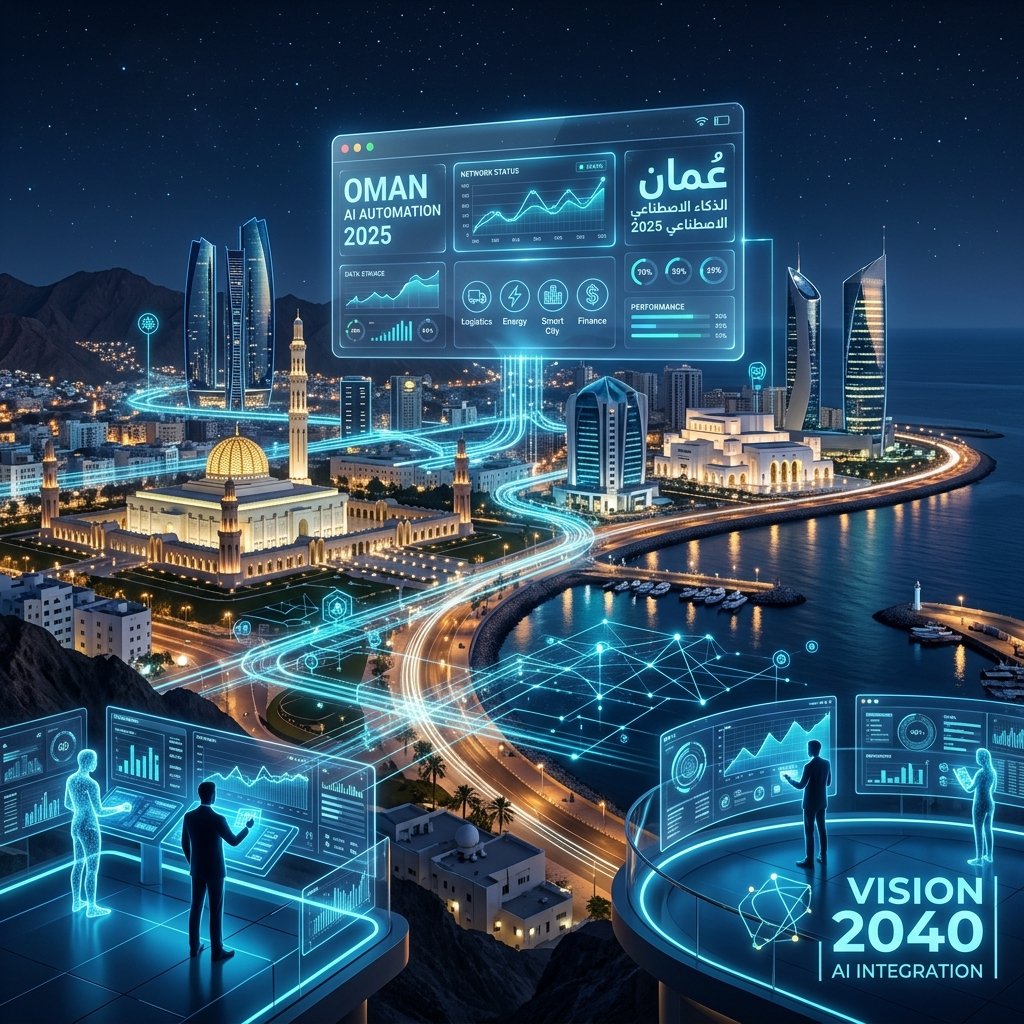
It is 9:30 AM at a mid-sized trading company in the Rusayl Industrial Estate. The owner, let's call him Ahmed, is staring at his phone. Three client WhatsApp messages from last night went unanswered. A logistics inquiry he meant to follow up on last Thursday has gone cold. And his sales coordinator just resigned — the third in 18 months. Ahmed's business is not failing because of a bad product. It is failing because his operations are still built for 2005 in a 2025 economy.
Across Muscat, from Qurum to Al Khuwair, from Sohar to Salalah, thousands of business owners are facing the same invisible wall: their growth is capped not by ambition, but by the manual, repetitive, human-bottlenecked processes that run their daily operations. The solution is not to hire more people. The solution is to automate the work that should never have required a human in the first place.
This is the definitive 2025 guide to AI automation in Oman — written specifically for local business owners, with local costs, local industries, and local context.
Why Does Oman's Vision 2040 Make AI Automation Urgent Right Now?
Oman Vision 2040 is the Sultanate's long-term economic diversification blueprint, targeting a reduction in oil revenue dependency from 68% of GDP to under 30% by 2040. The strategy explicitly identifies digital transformation and knowledge-based industries as primary pillars of this transition. The government's companion framework, the Digital Oman Strategy, calls on both public institutions and private SMEs to adopt technology that raises workforce productivity and reduces administrative overhead.
What this means practically: the Omani government is actively building an ecosystem that rewards businesses that digitize. ITA (Information Technology Authority) grant programs, OPAL (Oman's SME development agency) support packages, and innovation sandbox programs from the Central Bank are all pushing in one direction — businesses that adopt smart technology faster will gain first-mover advantages that their slower competitors cannot bridge later.
"The businesses that will lead Oman's private sector in 2035 are making their technology decisions in 2025." — AI Profit Lab Strategy Team
AI automation is not a luxury add-on for large corporations. It is the core mechanism by which an Omani SME with 5 employees can operate with the output efficiency of a 15-person company — without the payroll, the HR headaches, or the training costs.
Which Omani Industries Are Already Adopting AI — and What Results Are They Seeing?
Let us look at the sectors driving the most automation activity in Oman right now.
1. Real Estate & Property Management
The Omani real estate sector — particularly in integrated tourism complexes like Muscat Hills and The Wave — handles enormous volumes of international and local property inquiries. Agents and developers who have implemented AI-powered lead qualification systems report a 40% reduction in time spent on initial client screening. A WhatsApp AI receptionist can gather a prospect's budget range, preferred location, nationality (for ownership eligibility checks), and timeline — all before a human agent is ever involved. This means agents focus exclusively on serious, pre-qualified buyers.
2. Logistics & Transport (Port of Sohar, Port Sultan Qaboos)
Oman's logistics sector is a national strategic priority, anchored by Port of Sohar and the expanding Duqm Special Economic Zone. Freight forwarding SMEs are using AI to automate shipment status updates to clients via WhatsApp, generate customs documentation drafts, and send proactive alerts when cargo milestones are hit. One Muscat-based clearing agent reported saving 12 staff-hours per week by replacing manual email updates with an automated messaging pipeline — a saving of approximately OMR 180/month at average local wages.
3. Hospitality & Tourism
With Oman's tourism sector targeting 11 million visitors annually by 2040, hotels, tour operators, and serviced apartment complexes are rapidly automating their booking inquiry management. AI systems handle FAQ responses 24/7 in both Arabic and English, confirm reservation details, and trigger upsell sequences for add-on services. Seasonality — a major challenge in Omani tourism — becomes easier to manage when an AI can respond to 200 off-peak enquiries at 2 AM without any additional cost.
4. Retail & E-Commerce
Omani retail SMEs selling on Instagram and WhatsApp — a dominant commerce channel in the country — are automating order confirmation, payment follow-up reminders, and post-purchase review requests. Automating the review request alone can increase Google Business profile ratings by 0.4–0.8 stars within three months, directly impacting visibility in local search results.
5. Construction & Contracting
Civil engineering and general contracting firms in Oman are using AI to monitor government tender portals (like Tender.gov.om) and receive instant alerts when relevant project bids are published. Previously, this required a dedicated staff member manually checking the portal daily. An automated scraper and alert system costs a fraction of that salary and never misses a publication.
What Does AI Automation Actually Cost in Oman?
This is the number one question Omani business owners ask — and the answer is far more accessible than most expect. Here is a realistic 2025 pricing breakdown based on the local market:
| Tier | Setup Fee (OMR) | Monthly Retainer (OMR) | Best For | Equivalent Staff Cost Replaced |
|---|---|---|---|---|
| Starter | 500 | 75 | Solopreneurs, new SMEs | Part-time receptionist (OMR 200/mo) |
| Growth | 1,200 | 150 | SMEs with 2–10 staff | Sales coordinator + admin (OMR 600/mo) |
| Enterprise | 2,500 | 300 | Established companies | Marketing + admin team (OMR 1,500+/mo) |
To put this in sharp perspective: a Growth-tier AI system at OMR 150/month replaces the repetitive functions of a OMR 350–600/month employee — while operating 24 hours a day, 7 days a week, never taking sick leave, and never resigning. The break-even point is typically reached within 60–90 days of launch.
How Do You Start? The 3-Step Automation Roadmap for Omani SMEs
Step 1 — Audit Your Repetition
For one full week, track every task your team performs that is identical or near-identical to a task performed the previous week. Common candidates in Omani businesses include: answering "what are your prices?", manually sending invoice reminders, copy-pasting lead data into spreadsheets, and posting the same type of social media content on a schedule. Every task on this list is a candidate for automation.
Step 2 — Prioritize by Cost of Failure
Not all repetitive tasks are equal. Prioritize automating the tasks where human failure is most expensive. In most Omani businesses, this is missed lead follow-up. A single missed B2B contract worth OMR 5,000 exceeds the annual cost of a Growth-tier automation package. Start there. Then move to customer communication, then to internal reporting.
Step 3 — Implement with a Specialist
Unlike off-the-shelf SaaS tools, effective AI automation for an Omani business requires local context: Arabic language support, WhatsApp Business API integration (the primary communication channel in Oman), OMR-denominated pricing in chatbot flows, and understanding of local business culture and timing. Work with a specialist who has built these systems for the GCC market, not a generic global platform that treats Oman as an afterthought. You can book a free strategy audit with AI Profit Lab here.
The Competitive Risk of Waiting
Here is the uncomfortable truth that many Omani business owners avoid: your competitors are not waiting for permission. A real estate developer in Al Mouj is already using AI lead qualification. A freight forwarder in Sohar is already automating client updates. A restaurant group in Mutrah is already running automated review generation campaigns.
Every month you delay AI automation, the operational gap between you and your early-adopter competitors widens. And unlike a new marketing campaign that can be copied overnight, a well-implemented AI automation system creates a structural efficiency advantage that takes months for competitors to replicate.
Vision 2040 has set the direction. The businesses that will be standing — and thriving — at the end of this decade are the ones making the technology decisions today. The investment is smaller than you think. The cost of not investing is larger than you realize.
Start with one automation. Measure it. Then scale. That is how every successful digital transformation in Oman's private sector has begun.
Frequently Asked Questions
What is AI automation and how does it apply to Omani businesses?
AI automation uses software to handle repetitive tasks like customer replies, data entry, and lead follow-ups automatically. For Omani businesses, this means operating 24/7 without extra staff, cutting overhead costs, and scaling faster — directly aligned with Vision 2040's productivity goals.
How much does AI automation cost in Oman?
Entry-level packages start from OMR 500 for a basic chatbot and lead capture system. Mid-level solutions with CRM integration average OMR 1,200, while full enterprise systems cost around OMR 2,500 one-time, with monthly maintenance between OMR 75–300.
Which Omani industries benefit most from AI automation?
The top industries are: real estate (automated lead nurturing), logistics and transport (route optimization), hospitality (booking automation), retail (inventory and support), and construction (tender monitoring and project management).
Is AI automation aligned with Oman Vision 2040?
Yes. Oman Vision 2040 explicitly targets digital transformation and productivity growth. The Digital Oman Strategy encourages SMEs to adopt technologies that reduce manual labor and increase output — AI automation is a direct enabler.
Does AI automation require technical staff to operate?
No. Setup is handled by specialists. Day-to-day operation requires zero coding — business owners interact with simple dashboards and WhatsApp interfaces they already know.
How fast can an Omani business see ROI from AI automation?
Most Omani SMEs recover their investment within 60–90 days through eliminated overtime, reduced staffing for repetitive roles, and increased lead conversion from automated follow-ups.
Can AI automate Arabic-language customer communication?
Yes. Modern AI tools fully support Arabic. AI Profit Lab builds bilingual Arabic/English automation systems specifically for the Omani and GCC market, including WhatsApp Business API flows in Arabic.
What is the biggest mistake Omani businesses make with AI?
Waiting. Many owners believe AI requires a large IT budget. A OMR 500 automation package can replace 20 hours of repetitive admin per week — saving more than its cost from month one.
How does AI help with missed calls and lost leads in Oman?
AI receptionist systems instantly respond to missed calls via WhatsApp, capture lead data, qualify prospects with pre-set questions, and schedule follow-ups automatically — so no client is ever lost to an unanswered phone.
Where can I get AI automation services in Oman?
AI Profit Lab is based in Muscat and specializes in done-for-you AI automation for Omani SMEs and enterprises — including WhatsApp AI receptionists, CRM automation, lead generation, CEO dashboards, and ROI tracking.
Is my business data safe with AI automation systems?
Reputable providers use end-to-end encrypted pipelines. AI Profit Lab builds systems compliant with data privacy best practices — your customer data stays within secure, controlled environments and is never sold or shared.
References
Ready to Automate Your Business Operations?
AI Profit Lab helps non-technical managers in Oman and the GCC deploy custom AI solutions, automated customer service systems, and real-time dashboards to slash overhead costs and eliminate manual busywork.
Book a Free 30-Minute AI Consultation